It was past midnight, and a man I have never met was describing the worst feeling in building. Tony Fadell — the iPod, the iPhone, the Nest — was deep in a podcast, and somewhere in the easy flow of war stories he mentioned, almost in passing, that General Magic, the company where he helped invent something very much like the smartphone, had shipped that future about fifteen years too early. He said it the way you mention an old scar. Not bitter. Just accurate.
I put the cup down, because I know that feeling from the smaller side, the side most of us actually build on. Not the clean tragedy of being wrong. The stranger one. Being right, and early.
Right and early is its own category of wrong.
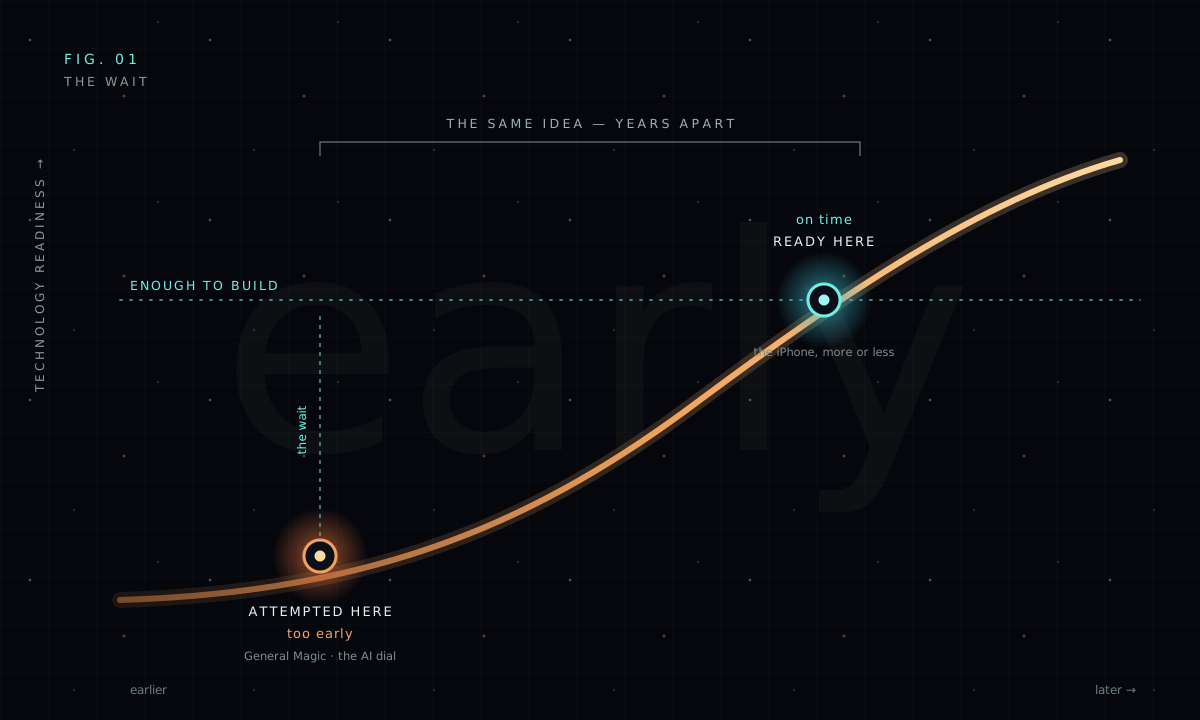
Most people hear too early as a gentle word for failed. Fadell does not. In his telling it is not a verdict at all. It is a coordinate. It says the pain was real, the aim was true, and the only thing you got wrong was the year. General Magic was the iPhone with the wrong number on the calendar. He tells people to go watch the documentary, where you can see brilliant engineers pouring themselves into something nobody could use yet, because the world had simply not shown up.
Underneath every gadget in that conversation was a single question, and it is the only one that really matters for anyone who makes things. How do you know what is worth building? And once you know — how do you survive being right before everyone else agrees?
Too early
Not a synonym for failed. It is the state of holding a real, durable pain and a true solution, missing only the enabling technology that has not quite arrived. The craft is in telling it apart from simply wrong — and then having the patience to wait out the gap without dying, or quitting, somewhere in the middle of it.
Pain, then a new physics
Start with the pain. Fadell does, every time, and he is almost embarrassed by how unglamorous it is.
Find an old ache — usually one so familiar that people have stopped noticing they carry it. Then ask the second question, the one that separates a business from a wish: has some new capability quietly arrived that can finally kill it? Not soothe it. Kill it. A pain everyone has tolerated for decades, met with a technology that became possible the day before yesterday. That is the whole formula, and both halves have to be standing in the room at once.
It multiplies, it does not add. A genuine pain times a genuine new capability can reorder a market. But if either term is zero, the product is zero, and no quantity of the other one rescues it. Most pitches I hear have one term and a great deal of hope.
The iPod is the cleanest proof. The ache was old — your music was trapped, heavy, and out of order. What was new arrived all at once: tiny portable hard drives, lithium cells that finally held a charge, compressed digital music, low-power chips. None of it usable two years earlier. All of it usable that year. Fadell did not invent a need. He stood exactly where four curves crossed and built the thing the crossing made possible.
The need is patient. The physics is not.
This is the mistake the current moment is built on. People have the new physics — astonishing models — and go hunting for a pain to justify it. That is the formula run backward, and you can feel it in every product that is obviously a capability in search of a reason. A breakthrough with no ache attached is a hobby with a marketing budget.
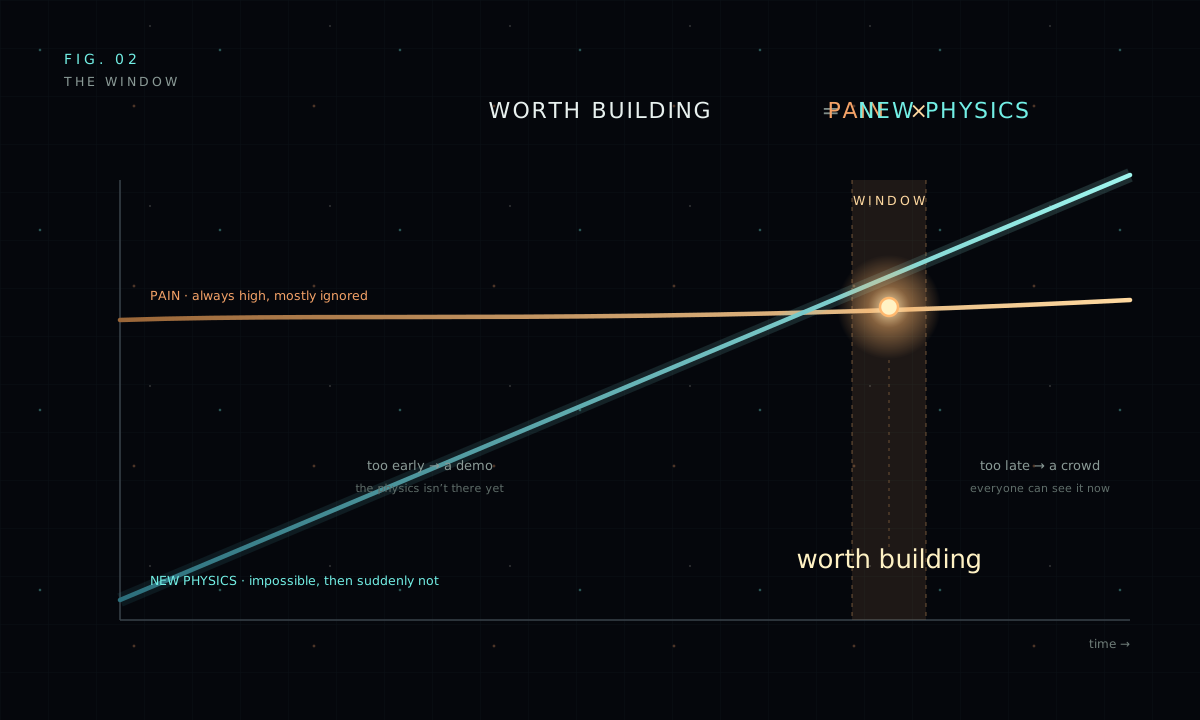
Pain without new physics is a complaint. New physics without pain is a toy. The window is the narrow stretch where both are finally true at once.
Three generations
Nothing works the first time. Fadell even has a number for how many tries it takes: three.
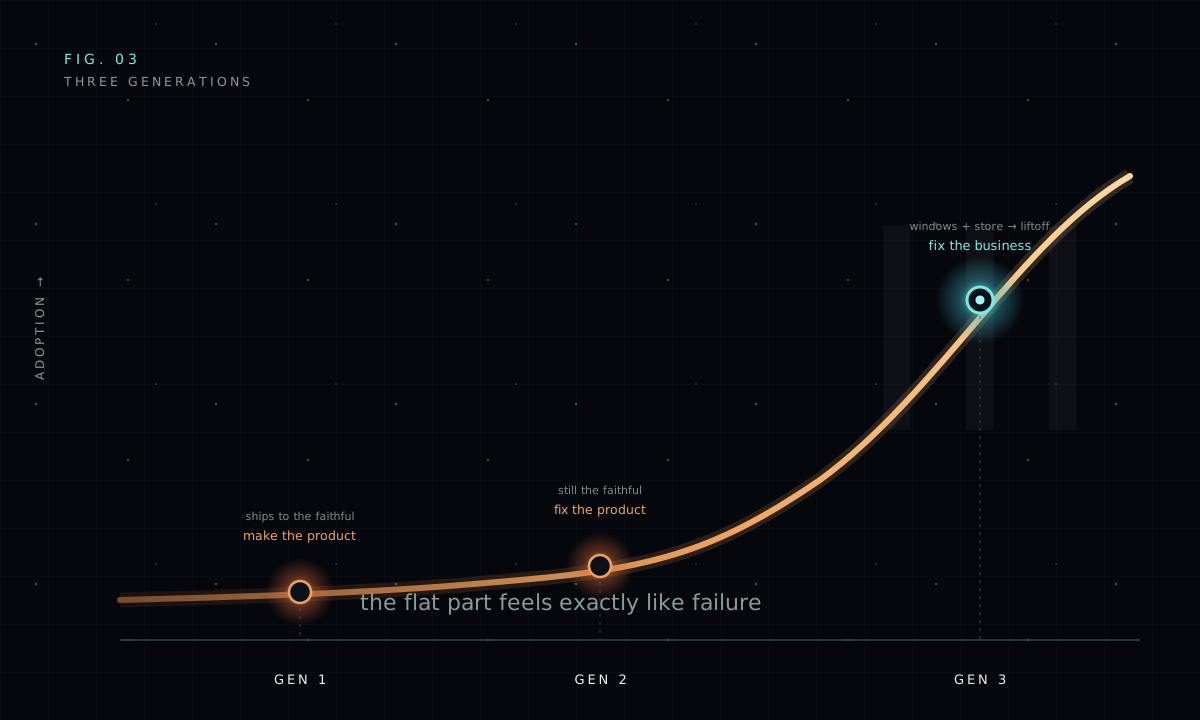
His rule is blunt. You make the product. Then you fix the product. Then you fix the business. He says he has never once seen anyone get all three on the first attempt — not even with Steve Jobs in the room insisting they had.
The iPod proves it better than any chart. The first generation sold only to the faithful, a sliver of the market who already owned the right computer. The second did the same — delight the believers, then go quiet. It was the third, the one that finally worked on Windows and arrived beside a real store, that turned a clever object into the machine that arguably saved the company that made it.
Two generations of being right and broke before the third one paid.
I hold onto this because the middle of it feels exactly like failure. Generations one and two are the flat part of the curve — the long, unrewarded stretch where the product is real and the numbers are not, and every instinct is screaming that you misjudged the whole thing. Most people quit there. They are not quitting on a bad idea. They are quitting on the schedule.
There is a line in Karma Yoga about acting without attachment to the fruit of the action. I used to read it as consolation. Now I read it as operating advice. The action is generation one. The fruit shows up two generations later, on its own timeline, indifferent to your need for it. If you demand the fruit at the moment of the action, you will either lie to yourself about the numbers or walk away on the flat part — and the flat part, from the inside, is indistinguishable from being early.
You do not get to skip generations. You only get to survive them.
Someone has to hold the opinion
Here is the part the data-driven crowd hates.
A true 1.0 cannot be decided by data, because there is no data. The thing does not exist yet; the category may not exist yet. Fadell is emphatic about this. For a genuine first version of something new, almost every important call is an opinion-based decision — and so you need one or two people with taste who are willing to own those opinions and be wrong in public.
He calls it, without flinching, a benevolent dictatorship. Not because consensus is evil, but because consensus on a 1.0 quietly averages a bold thing into a safe, dead one. The famous fight over the iPhone keyboard was exactly this. The data was genuinely ambiguous — real arguments on both sides, no clean winner. So someone with conviction decided, said we are going this way, and told the people who could not get on board to go work on something else.
Ambiguous data is not a reason to wait. It is the moment taste has to do its job.
This is uncomfortable because the whole culture now runs the other way. We hire the study, run the test, convene the panel — and a panel has never once seen the 1.0 in full context, because the full thing does not exist for them to react to. So we gather data on a product that isn't there and call our hesitation rigor. Fadell's word for it is sharper: covering your ass. The real builders make the call, own it, and stand under the heat when it turns out wrong.
Data is how you refine a thing that exists. Taste is how you decide a thing that doesn't yet.
The whole thing, not the gadget
The product is never the product.
This was the lesson hiding under every story, and the one technologists resist the longest. The iPod was not the iPod — it was the iPod plus the software plus the store. The iPhone was not the phone — it was the phone plus the App Store. You are never building the single object you will be remembered for. You are building the system that lets that object exist, and the object is just the part small enough to hold in one hand.
Then comes the part engineers treat as someone else's department and discover, too late, is the work itself. Marketing. Story. The why.
Fadell is almost evangelical here, which is startling from a hardware man. The customer, he keeps saying, only ever meets your product through the lens of marketing — never the way you meet it, from the inside, knowing everything. He writes the press release before he writes the product, because if the thing will not compress into three or four features a human can actually hold, he has not finished deciding what it is. Cutting two of three tentpole features to ship sooner is not a small trade. It is shipping a weaker, different product and hoping nobody notices.
When you are technology-led, you describe the what. The customer lives entirely in the why.
He points at the obvious giant to make it sting — an astonishing demo that went viral and took years to ask the unglamorous question of what, exactly, a normal person is supposed to do with it every day, while quieter teams that began from the use case kept compounding. The demo wins the week. The product wins the decade. Nobody has ever fallen in love with a spec sheet.
Story is not perfume you spray on a finished product. If it does not already sing from inside the thing, you built the wrong thing.
Craft is the moat now
There is a smoke alarm in here, and it matters more than it sounds.
Fadell lights up describing one tiny feature: before the alarm blares, a calm voice tells you it is about to. It is about to make a loud noise. The detail is almost nothing, and it is the entire philosophy. Someone cared enough about a stranger's two seconds of panic to engineer those seconds away. He keeps using a word engineers are shy of. Love. There was a lot of love poured into that thing, you can feel it, and feeling it is exactly what makes people trust the brand with the next thing.
Care is legible. So is its absence.
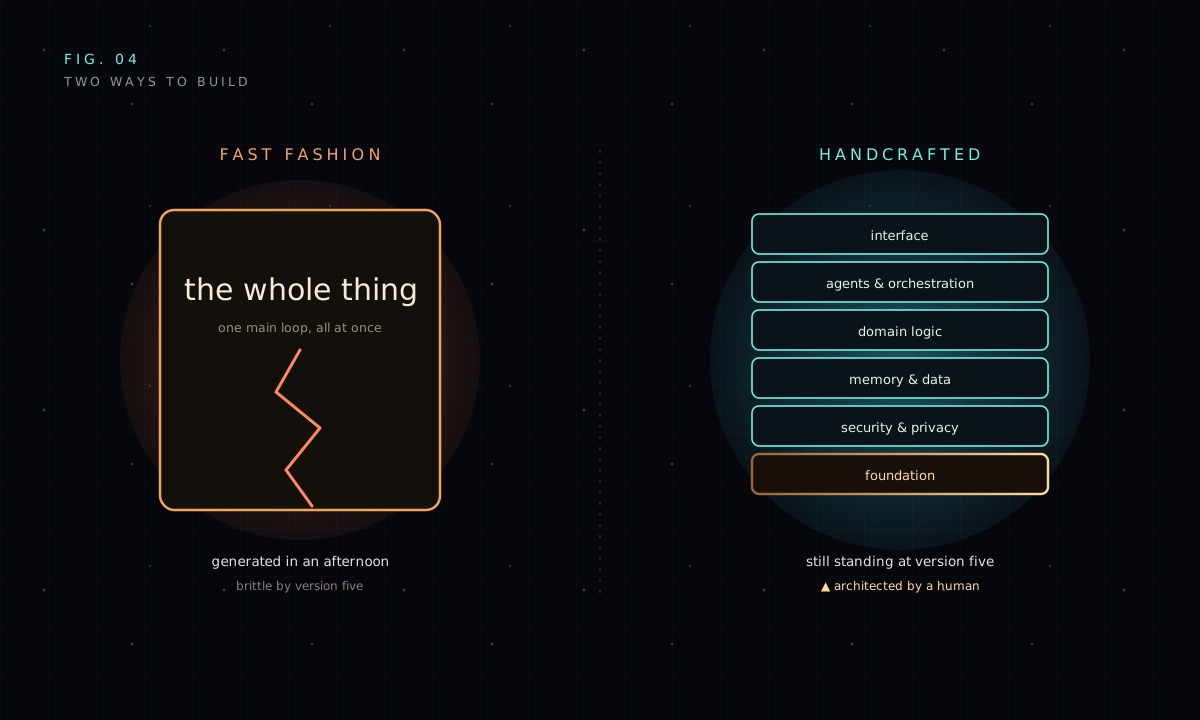
Which is why the next part landed the way it did. He brought up the moment a chunk of a frontier lab's own source leaked, and how the real architects who looked at it recoiled — the main loop reading as one enormous undifferentiated block where there should have been a dozen clean layers. It works. It tests. You still cannot reason about it, roll it back cleanly, or trust its seams. He has a name for what that produces at scale. Fast fashion. Software you can generate in an afternoon and cannot maintain by version five. Technical debt, delivered as a service, with a smile.
I will say the obvious thing once and move on. I thought these notes through with the same kind of machine he is warning about. The point was never to never touch it. The point is who keeps the pen.
Because his actual argument is not anti-machine, and that is what makes it serious. Use it to prototype — make ten throwaway versions and buy yourself an informed gut faster than ever before. Then draw the architecture yourself, by hand, and scope the machine down to the small, bounded rooms inside a structure you understand. The taste, the load-bearing walls, the why — those do not get handed over. His analogy is H&M against something handcrafted: you can generate a copy that photographs beautifully and falls apart in a season, or you can build the version that lasts because a human understood why every seam was where it was.
The danger was never that the machine writes bad code. The danger is cognitive surrender — handing over the thinking along with the typing, until you are a very intelligent forwarding service for a system you have stopped understanding.
Use the machine. Do not become a very efficient way of forwarding it.
How it goes wrong
Hold the two-term test and the common failures start to name themselves.
Chasing the hot thing. By the time a category is obviously hot, the window has shut and you are paying for a success you did not earn. Fadell has watched four of these cycles. His line is exact: when it is already hot, it is already too late.
Cognitive surrender. Letting the speed of the tool convince you the thinking is also done. It isn't. It is only hidden.
Checkbox bloat. When building is cheap, the temptation is to build everything, and everything is a product with forty features and no spine.
Perfuming the pig. Treating story as a coat of paint at the end, instead of the discipline that forces you to know what you are making before you make it.
The middle line is the whole game now. Prototype speed has gone to near-infinite for everyone, which means it is no longer an edge. The only term left that compounds is the one a human still has to supply.
What I am keeping
A few habits, less tidy than they sound.
Write the press release first. Before the spec, before the schematic. If it will not compress into three features a stranger would repeat to a friend, it is not finished being decided.
Start from the ache, not the breakthrough. The new physics is the easy half to fall in love with. The pain is the half that tells you whether anyone will actually care.
Respect the three generations. Treat the first as a question, the second as the answer, the business as the thing that arrives after the answer is good. Do not grieve the flat part. It is supposed to be flat.
Hold the opinion when the data won't. On a real 1.0, ambiguous data is not permission to wait. It is the moment taste has to decide, and own it.
Prototype with the machine; architect without it. Generate ten versions to find the gut feeling, then draw the walls yourself. Never the load-bearing ones.
The patient version of conviction
I started the night feeling validated and ended it feeling something more useful, which was sober.
Validated, because the principles are clean and they are right. Sober, because the same man spent the rest of the hour cataloguing how many ways there are to waste a true idea. Be too early and quit before the world arrives. Mistake the flat part for failure. Confuse the gadget for the system. Fall for your own demo. Hand the pen to the machine.
None of those are technology problems. They are problems of patience and ownership — which are precisely the two things the hype cycle is engineered to destroy.
There is a move I keep returning to: step back into the witness before you react. You do not control the window. When the physics arrives, whether the world is ready, whether you were born too early like General Magic or on time like the iPhone — none of that is yours. What is yours is fidelity. To the pain. To the craft. To the pen.
Being early does not guarantee that a market will arrive, or that I can afford to wait for it. The difficult judgment is deciding which evidence should keep me going and which should change my mind.
The window is not yours to choose. The only things you control are whether you started from a real pain, and whether you are still the one holding the pen when it opens.
It was very late when the episode ended. For once I closed the laptop and did not open it again to fix one more thing. The work would still be there in the morning. So would the wait.