On a clear night, find the bend in the handle of the Big Dipper, look hard at the middle star, and a second fainter star swims into view right beside it. The Sanskrit tradition called them Vasishtha and Arundhati, a sage and his wife, and somewhere more than three thousand years ago a poet wrote down which of the two was walking ahead.
Stars drift. Over thousands of years that pair slowly trades which one leads, and the drift runs in a direction you can calculate, forwards or backwards, with nothing fancier than orbital mechanics. So that one line isn't only poetry. It's a timestamp. A clock somebody left running inside a text, waiting for a reader patient enough to wind it back.
In Indian astronomy the Big Dipper is the Saptarishi, the seven sages. Vasishtha is the middle star of the handle; Arundhati, his wife, is the faint companion riding beside him. Which of the two appears to walk ahead shifts across thousands of years, so a hymn that records the order is quietly recording a date.
Here's the part that should bother you more than it does. The date in your school textbook for the oldest of these texts, the Rig Veda, somewhere around 1500 BCE, didn't come from that sky. It didn't come from the river the hymns describe, or the dirt under the ruins, or anything anyone ever put an instrument to. It came from a man in Oxford who needed a number and picked one.
It was a guess.
This essay isn't really about whether the Vedas are four thousand years old or twelve thousand. It's about the thing underneath that fight: how we decide how old anything is, and what happens when an assumption gets to walk around dressed as a measurement for a century and a half. The age of Indian civilization is the cleanest example I know of a number that everyone treats as data and almost nobody has actually checked.
So let us check it.
Where the Number Came From
The number has a father, and the father had doubts.
It came from Friedrich Max Müller, the great nineteenth-century philologist who edited the Rig Veda for Europe and did more than anyone to carry it west. I'm not interested in making him a villain. He loved these texts. But the date he hung on them wasn't a discovery. It was arithmetic done on top of assumptions.
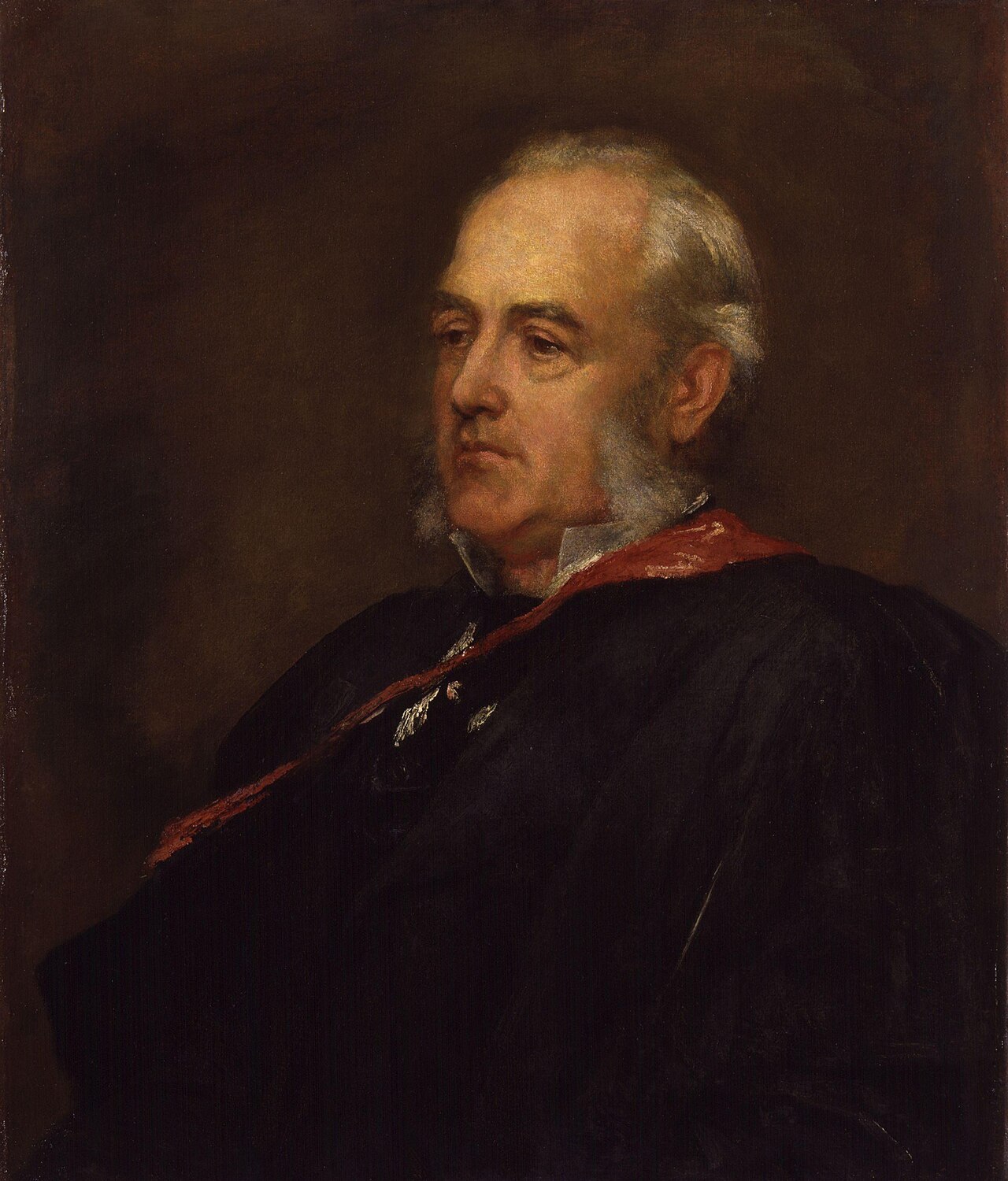
Friedrich Max Müller, who gave the Rig Veda its famous date by counting backwards through assumptions, and who admitted, late in life, that no power on earth could ever really fix it.
Portrait by George Frederic Watts. Public domain, via Wikimedia Commons.
His method ran in reverse. He fixed a late point he felt sure of, the time of the Buddha, around 500 BCE, and then counted his way upstream through the visible layers of Vedic literature. Above the hymns sat the ritual manuals, then the commentaries, then the speculative texts, four rough strata stacked one on the next. He gave each layer about two hundred years to be born, matter, and fade, added them up, and landed near 1200 BCE for the oldest hymns. Round it off for the start of the Vedic age and you get the 1500 BCE we all grew up reciting.
It was carbon dating without the carbon.
Two hundred years a layer came from nowhere in particular. Some bodies of text harden in a single generation. Others stay liquid for a thousand years. He chose a round, modest interval because he needed one to finish the sum, and because a devout Christian Europe had firm opinions about how far back anything was allowed to reach before it started to embarrass the Book of Genesis.
To his real credit, Müller eventually said all of this himself, out loud. Late in life he wrote that whether the Vedic hymns were composed in 1000 or 1500 or 2000 or 3000 BCE, no power on earth would ever settle it. The man who minted the number told us, in plain words, that it wasn't a measurement.
Nobody listened. The number had already left home and found work.
A guess repeated for a hundred and fifty years doesn't slowly turn into a measurement. It turns into a habit. And this particular habit married a story that Europe found very easy to live with: that fair-skinned Aryans rode into India around 1500 BCE, beat the locals, and composed the Vedas as the victory song of the winners. Notice the convenience of the timing. The conquerors showed up right when the empire writing the schoolbooks wanted a precedent for itself.
An inherited date
A date you measure is a claim about the world. It can be wrong, and evidence can show that it's wrong. A date you inherit is a claim about who you trust. The only way to shake it is to be a little rude, to ask where the number came from and refuse to stop asking. The 1500 BCE we were handed is the second kind, wearing the clothes of the first.
Once you notice that difference, you can't stop noticing it. A surprising amount of what a culture calls common knowledge turns out to be inheritance with the receipt thrown away.
Say a soft number with a straight face, print it in enough textbooks, and let it sit. The evidence never gets any better, but the confidence keeps compounding. Give it a century and the number feels like bedrock, and the people standing on it have forgotten it was poured, not quarried.
From first principles, there are only a few witnesses to the age of this civilization who owe Max Müller nothing at all. The sky. The river. The ground. The genome. So I went and asked each of them, and I've tried to write down the answers honestly, including the places where the witness flatly refused to say what I was hoping to hear.
Honest auditing means reading out the lines that go against you too.
Every serious method lands somewhere on this line. The number we were handed sits at the young, convenient end, and it's the one date no instrument ever measured. Underneath all of it, the ground shows continuous settlement and no invasion.
The Sky
Start with the witness no empire can lean on.
The sky is a clock nobody owns. Precession, the slow wobble of the Earth's axis, plus the drift of individual stars, means the night over India eight thousand or three thousand years ago sat in a measurably different position from tonight's, and the difference runs in a known, reversible direction. If an old text records a real arrangement of the sky precisely enough, you can in principle solve it for the year the author looked up. This is the most thrilling idea in the whole argument, because it walks straight around human authority.
Nilesh Nilkanth Oak has pushed this harder than anyone alive. He reads the astronomy scattered through the Mahabharata and Ramayana literally and asks which year the sky actually matched. His most famous anchor is the pair of stars I opened with. The Mahabharata, in the Bhishma Parva, has Arundhati walking ahead of Vasishtha, Alcor ahead of Mizar, recited by the sage Vyasa as a bad omen on the eve of the war. From that, plus a stack of some two hundred other references, Oak lands on 5561 BCE for the Mahabharata war, and from more than five hundred for the Ramayana, on a frankly startling 12209 BCE.
Hold the exact years loosely for a second, because what I admire here and what I distrust are two different things, and running them together is how people get this wrong in both directions.
What I admire is the shape of the method. It's falsifiable. Oak isn't leaning on faith or on feeling. He is making a claim about photons that either matched the sky in a given year or didn't, and you can go check. People have.
And when they check, the specific dates start to wobble.
This is the honest part, and I'm not going to skip it. Oak is contested hard, and not only by Western Indologists with a colonial reflex. Other traditional sky-watchers, running the same verses through the same planetarium software, put the Mahabharata war closer to 3067 BCE, nowhere near 5561. Critics like Raja Ram Mohan Roy have written long, patient refutations arguing his anchors come apart on their own grammar, that a star pattern which takes thousands of years to shift can't really do the job of a sudden omen the night before a battle. Mainstream scholarship files the whole project under fringe and walks on.
So the sky hands an honest auditor a split decision. The method is right and the precision is oversold.
The instrument is sound. The reading is in dispute.
What is left standing is smaller than Oak says and a great deal bigger than the textbook admits. The texts really do carry sky-states inside them, those states point early rather than late, and the question is one you settle by computing, not by checking who holds which chair at which university. That by itself should make you wary of any single confident number, the textbook's 1500 BCE very much included.
The sky is the one witness you can't bribe, exile, or hand a professorship. Which is exactly why it makes everyone a little uncomfortable.
The River
The second witness is a river that isn't there anymore.
The Rig Veda sings about a river called the Sarasvati, and it doesn't sing quietly. It calls her the greatest of rivers, born in the mountains, outdoing all the others in sheer force, running from the peaks down to the sea. And it puts her exactly where the geography says she should be, in the gap between the Yamuna and the Sutlej.
There's no mighty river in that gap today. There's a dry bed.
And the dry bed is real. Satellite imagery and ground survey have traced a wide buried channel running straight through the gap, an old large river course now sleeping under sand and farmland, with hundreds of archaeological sites threaded along it like beads on a string. Something big flowed there once. On that much, nobody really argues.
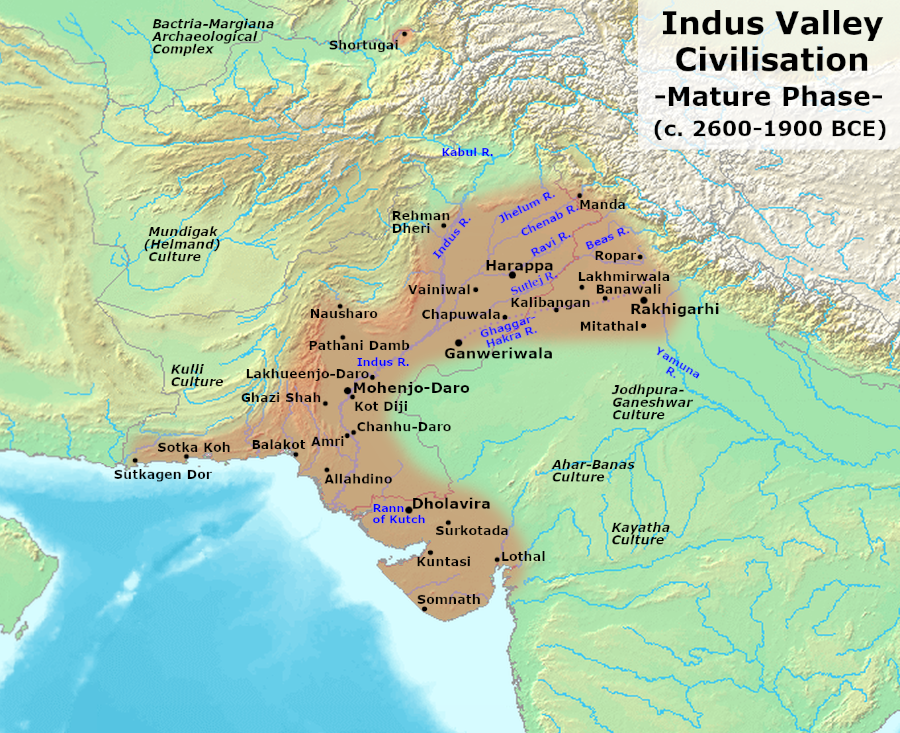
The cities and towns of the mature Indus-Sarasvati world, strung along the rivers like beads. Notice how many sit on the now-dry Ghaggar-Hakra, the channel the hymns seem to remember as the Sarasvati.
Map: Avantiputra7, CC BY-SA 3.0, via Wikimedia Commons.
The fight is about when it stopped.
And here, if I'm honest, the evidence won't hand my side a clean win. The best modern geology, uranium-lead dating of the channel sands by Peter Clift's team in 2012, sediment work by Liviu Giosan the same year, luminescence dating by another group in 2017, all tells one steady and inconvenient story. The big Himalayan, glacier-fed rivers that would have made the Sarasvati genuinely mighty walked away from this channel a very long time ago. The Yamuna swung east, the Sutlej swung north, and the best estimates put that capture thousands of years before the Harappan cities hit their peak. By the second millennium BCE, the channel was most likely a seasonal, rain-fed river already on its way to dying, not a glacial flood.
So the maximal claim, a perennial mountain river still roaring while the hymns were sung, isn't supported by the best geology, and I won't pretend it is. An Indian government remote-sensing report happily states that the Rig Veda was "probably composed more than 8000 years ago," but that line was written by satellite engineers, not philologists, and it sits in the report as an aside, not an argument. I'm not going to lean on evidence I'd laugh at if the other side used it.
But watch what the river does next, because the logic runs in both directions at once.
It's symmetric, and it's the most interesting move in the entire debate. If the Rig Veda really is describing a mighty, mountain-born Sarasvati, and the Sanskrit is honestly hard to read any other way, then exactly one of two things has to be true. Either the hymn is very old, sung while the river was still great, which drags the Veda well past 1500 BCE. Or the hymn is younger and the "mightiest of rivers" is poetry, a memory, an exaggeration, a goddess painted bigger than her actual water.
The same words date the text early or late, depending on which answer keeps the inherited number safe. Watch for the moment the argument quietly decides the river was only a metaphor.
You don't get to have it both ways. And the mainstream quietly takes the second door, which is fair enough, except watch the footwork. The same scholars who treat the hymns as precise historical reporting when that precision dates them late will reach for "metaphor" the instant the river's size threatens to date them early. The Sarasvati gets to be literal or literary depending entirely on which reading keeps the inherited number safe.
That isn't how you treat a witness. That's how you treat an alibi.
A civilization sang about a river for centuries. The river dried, the people walked east after the water, and we've spent two hundred years arguing about whether they were allowed to have meant it.
The Ground
The third witness is the dirt, and the dirt is where the old story quietly dies.
Dig along that river system and you don't hit a break. You hit depth. At Mehrgarh, out on the western edge, farming villages run back to roughly the seventh millennium BCE: wheat, barley, herds, mudbrick granaries, even drilled teeth from the oldest dentistry we know of, the same people developing in the same place for thousands of years before the great cities ever go up. This isn't a frontier that got overrun and swapped out. It's a hearth that just kept burning.
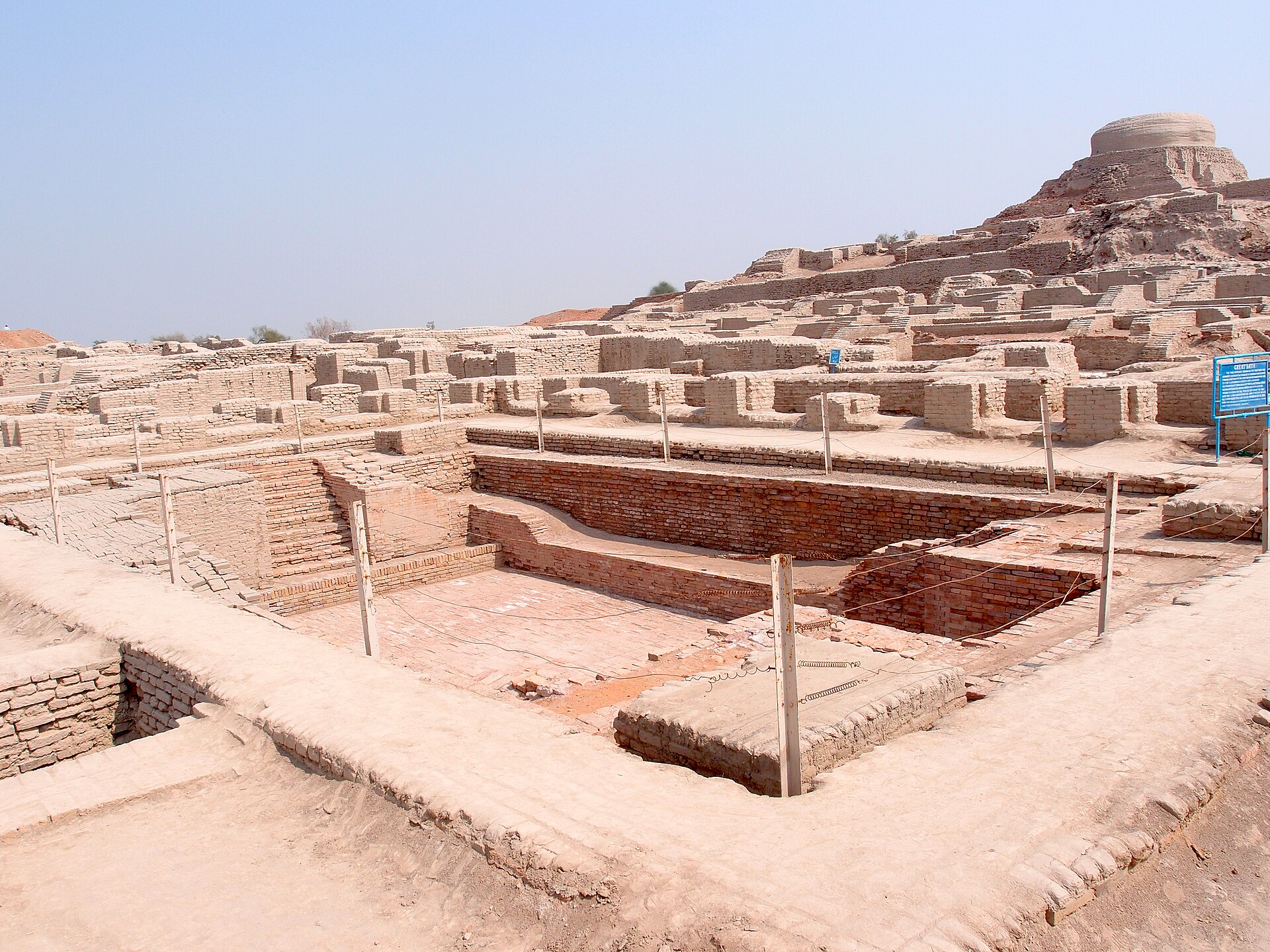
Mohenjo-daro today, with a later Buddhist stupa on the mound behind. No burned gate, no battle line, no invasion. The city was abandoned, not stormed.
Photo: Saqib Qayyum, CC BY-SA 3.0, via Wikimedia Commons.
Then the cities, Mohenjo-daro, Harappa, Rakhigarhi, Dholavira, mature around 2600 BCE, run strong for seven centuries, and fade after about 1900 BCE. And here's the fact that should have killed the invasion story decades before it actually died: there's no invasion layer.
No cities burned on cue for the supposed Aryan arrival. No mass graves of slaughtered defenders. No sudden swap of one whole material culture for another. The decline follows water and weather, a weakening monsoon, rivers rearranging themselves, and the people do the obvious human thing when the water moves. They move with it, drifting from the southwest toward the northeast, toward the Ganga. Migration, not massacre.
The massacre, as it happens, was made up.
Mortimer Wheeler, digging at Mohenjo-daro in the 1940s, found a few dozen scattered skeletons and announced that the god Indra and his Aryan hordes stood accused. It was vivid, it fit the textbook, and it was wrong. Later forensic work showed the skeletons had died across different centuries, plenty of them with no sign of violence at all, and none of them belonging to a single battle. Wheeler had dug up an ordinary scatter of the dead and built a war on top of it, because the war was already sitting in his head before the trowel ever went in.
He found what the story told him to find. We all do, right up until somebody audits.
So the ground is the strongest witness for the deep case. Not because it shouts a date, but because it quietly removes the event the late date was leaning on. Take away the invasion and 1500 BCE loses its anchor. What is left is continuity: one civilization, deep roots, drying out and moving on rather than getting conquered.
The Aryan invasion was never found in the ground. It was found in a library, and then it went looking for skeletons to back it up.
The Genome
The fourth witness is the one everybody now wants to end the argument, and it's the least cooperative of the lot.
Ancient DNA was supposed to be the referee. Instead it turned into the new battlefield, and the headlines coming out of either camp tell you more about the reader than about the genome. Let me give the honest state of it, including the part that doesn't flatter me.
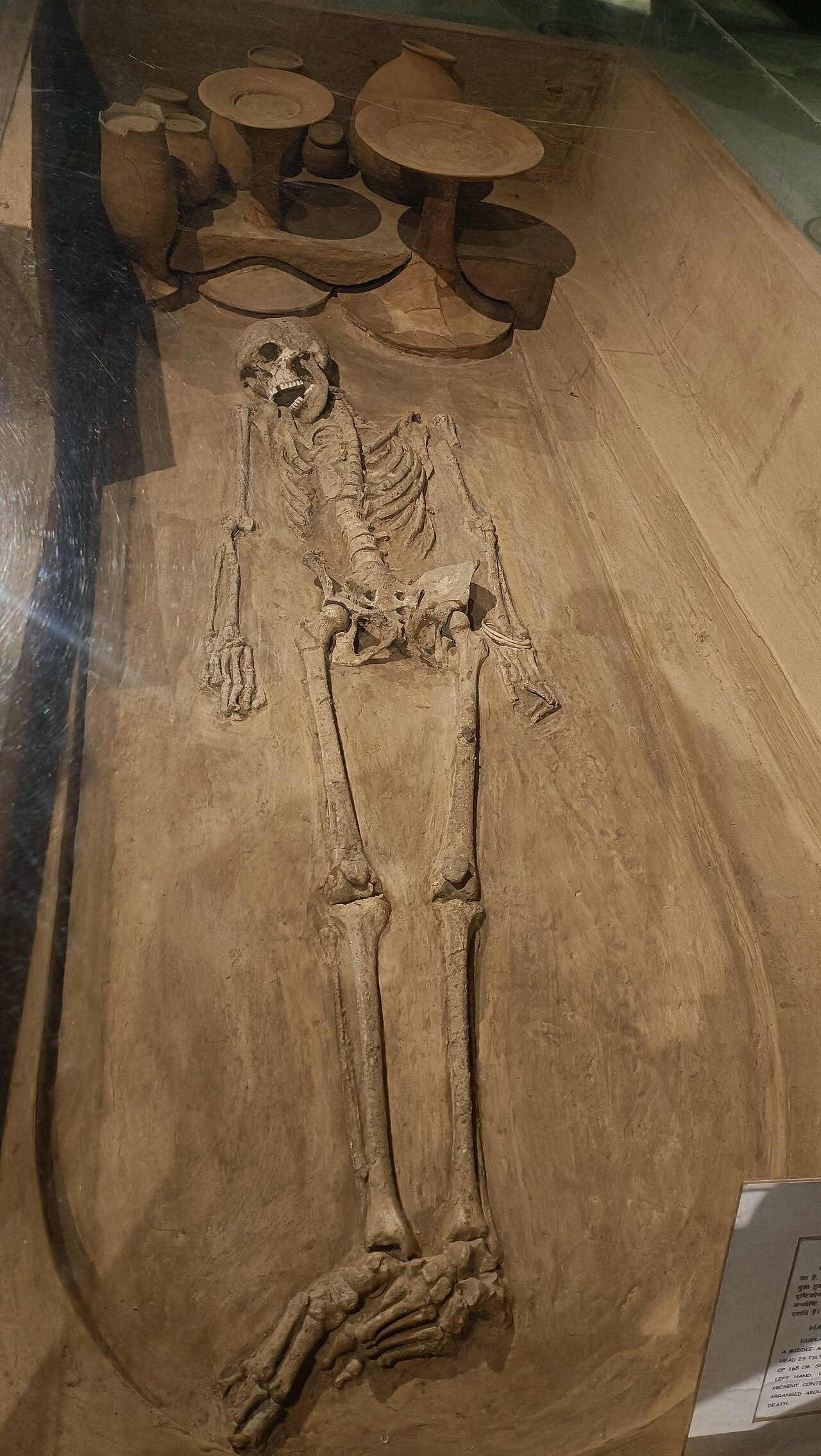
A Harappan burial at Rakhigarhi, laid out with its pots. This is the kind of resting place ancient DNA is read from, and the reading has reopened the oldest argument in Indian prehistory rather than closing it.
Photo: Aadrit28, CC BY-SA 4.0, via Wikimedia Commons.
The DNA pulled from the Indus world, most famously a single individual from Rakhigarhi published by Vasant Shinde's team in 2019, describes a population built from indigenous South Asian hunter-gatherers blended with Iranian-related farmers, with no meaningful "steppe" ancestry in that Indus individual. The same year, a much bigger study led by Vagheesh Narasimhan traced steppe-related ancestry moving into and through South Asia mostly in the second millennium BCE. Indigenists read the first result as proof the Harappans weren't newcomers. Migrationists read the second as proof that somebody did arrive. Both results are real. They aren't even in conflict.
The mistake is older than either paper, and it's the original sin of this whole field.
The nineteenth century packed four different things into one crate and stamped Aryan on the side: a body, a language, a pot, and a god. Same people, same arrival, same date. That was the assumption, never the finding. But genes, grammar, pottery, and religion are four separate systems with four separate histories. People can pick up a language without swapping out their grandparents. Genes can travel without an army. A goddess can outlive the river she was named after by three thousand years.
The nineteenth century shipped genes, language, pottery, and gods as a single parcel and stamped it Aryan. They were always four separate systems with four separate histories. Genes are not grammar.
Genes aren't grammar. A skull isn't a sentence.
So whatever the ancient DNA finally shows about who moved when, it doesn't date a poem on its own. A thread of steppe ancestry arriving around 1500 BCE, if that's what happened, proves the arrivals wrote the Rig Veda about as well as the English spoken in Delhi proves Chaucer was born on the Yamuna. The genome can testify about bodies. It can't read Sanskrit.
Nearly every confident claim in this argument is really four claims sharing one coat. Pull them apart and most of the confidence ends up on the floor.
The Strongest Case Against Me
Now the part honesty demands, the part most people on my side of this quietly walk past.
If all you do is knock over Müller's two-hundred-years-a-layer guess, you're beating a dead man. The serious modern case for a second-millennium Rig Veda doesn't rest on Müller at all. It rests on Michael Witzel, the Harvard Sanskritist and probably the leading living scholar of the Veda, and it isn't a guess. It's a cage built out of several independent bars, and it's the best argument on the field. I'm going to give it at full strength, because an argument you have to weaken before you can answer was never really answered.
Three constraints, none of them Müller's, none of them astronomical, all closing on the same narrow window. This is what a real argument looks like, and it deserves a real answer instead of a wave of the hand.
Walk the bars. The Rig Veda mentions ruins, armaka, but never a single living Harappan city, which reads like composition after those cities had already fallen, so after 1900 BCE. It knows ayas, copper and bronze, but shows no sign of iron, and iron only turns up in the later Atharvaveda. Since iron reaches the region around 1200 BCE, the oldest hymns probably sit before it. And then the checkpoint that's genuinely hard to wriggle out of: a treaty between the Hittites and the Mitanni in northern Syria, around 1380 BCE, swears by Mitra, Varuna, Indra, and the Nasatyas. Rigvedic gods, named, in the Middle East, in writing we can date on its own. Witzel even sorts the hymns by royal and poetic lineage into a fine internal sequence, three stages running from about 1700 to 1200 BCE.
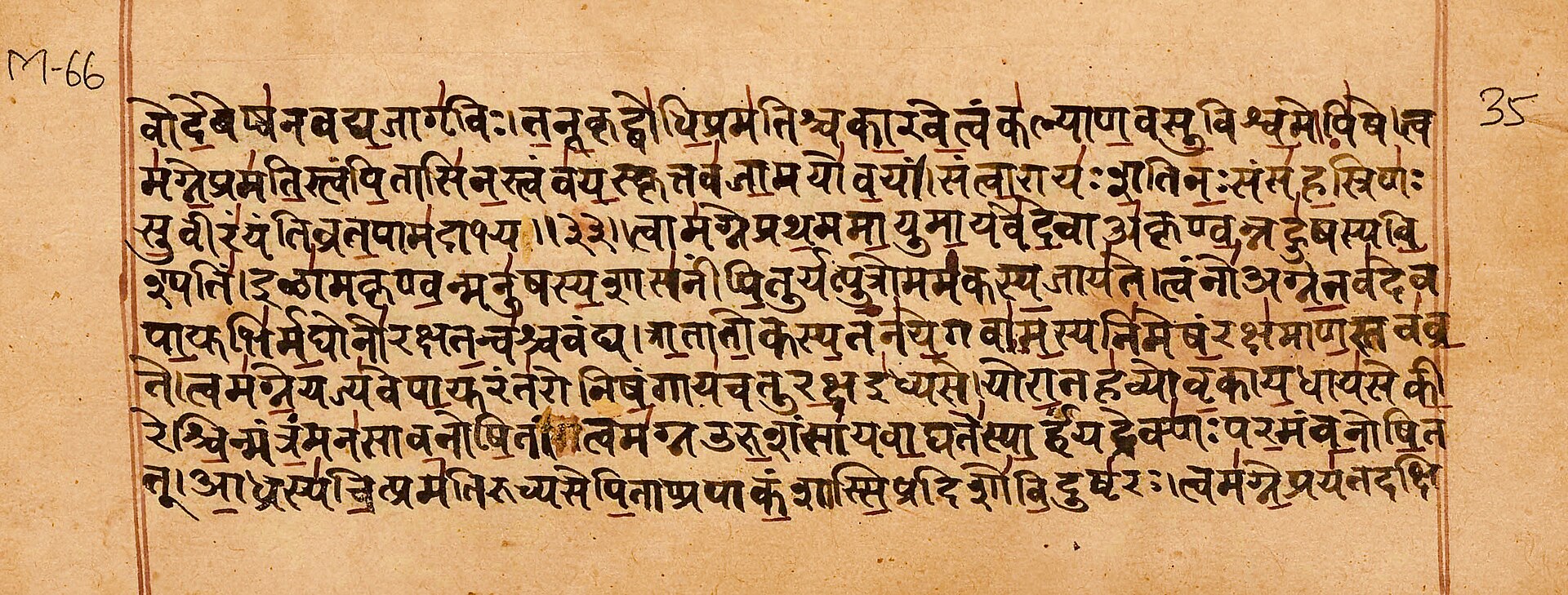
A Rig Veda manuscript in Devanagari. The paper is recent, the words aren't. The text rode on memory, syllable for syllable, for thousands of years before anyone wrote it down, which is the whole reason its true age is so hard to pin.
Photo: Ms Sarah Welch, CC BY-SA 4.0, via Wikimedia Commons.
That's a serious cage. I'm not going to pick the lock with a slogan.
The deep-antiquity replies to it are real, but they aren't knockouts, and I will give them as exactly that. The Mitanni gods can be read the other way, as Indo-Aryans leaving India and carrying their gods west, rather than arriving from it. "Ruins, not cities" assumes the hymns are describing the Harappan world in the first place, and not some other ruined landscape. The iron ceiling dates the absence of a word, which is always weaker than the presence of one. These are fair answers. They aren't a finish, and anyone who tells you they are is selling something.
Honesty means saying it without squirming: the strongest version of the other side is strong.
What it isn't is the thing it quietly poses as. It isn't a measurement of when the Rig Veda was composed. It's a tightly argued ceiling on when Indo-Aryan language and gods were clearly present, which is a different question wearing a similar face. Witzel himself, fairly, calls the 3000 BCE datings fantastic. I'd only add that 1500 BCE, recited with the confidence of a settled fact, is fantastic in the older sense of the word too: a fantasy we got comfortable inside.
What the Audit Actually Shows
So where does the audit land? Not where my own bias wanted it to.
I can't honestly tell you the Vedas are twelve thousand years old. Oak's specific dates don't survive the people checking his sky. I can't tell you a glacial Sarasvati was roaring through the hymns, because the geology says it had already thinned to a rain-fed stream. The genetics, read straight, lean toward some real movement of people in the second millennium BCE. If I buried those three facts to tell a tidier story, I'd be doing the exact thing Wheeler did, just from the opposite chair.
But that was never the claim worth defending.
Here's what the audit does establish, and it's plenty. The confident 1500 BCE in the textbook is an inheritance, not a measurement, minted by a man who admitted to our faces that he was guessing. The civilization sitting under it is clearly far older and far more continuous than the invasion story ever allowed, rooted at Mehrgarh seven or eight thousand years down, fading by drought instead of conquest, with no invasion layer anywhere in the dirt. The two witnesses that point early, the sky and the river, are exactly the two the late date has to talk its way around in order to survive. And the whole structure of certainty was built by bundling genes, language, pottery, and gods that we now know traveled separately, on different roads, at different speeds.
Older than we were told. Less certain than either side likes to pretend. Both true at the same time, and only one of them ever made it into the syllabus.
The Means of Knowing
There's a last irony here, and it's the kind I find hard to look away from.
The civilization whose age we're squabbling over produced, inside its own philosophy, the most careful theory of knowledge in the ancient world. The Indian schools were obsessed with pramana, the valid means of knowing, and they ranked them. Pratyaksha, direct perception. Anumana, inference. Shabda, testimony, the knowledge you take on because a trustworthy source handed it down to you.
And they were blunt that shabda is the weakest of the three. Testimony counts as knowledge only when its source is reliable, and only as long as it isn't contradicted by what you can see and reason out for yourself. The moment your own eyes or your own logic say otherwise, the inherited word loses. It doesn't get to pull rank.
Indian philosophy ranked the ways of knowing and put inherited testimony last, valid only until perception or inference contradicts it. We dated the whole civilization on that bottom rung, and let it overrule the sky and the ground.
Now look at what we did to the age of that very civilization.
We dated it almost entirely by shabda. By testimony. By a number passed down from an authority who told us himself that it was a guess. And we let that testimony stand even while perception, the dry riverbed, the unburned cities, the deep continuity in the ground, and inference, the sky, the two-way logic of the Sarasvati, were both pulling the other way. We picked the weakest tool in their own kit and then called the result settled science.
I build memory systems for a living, and one idea from that work won't leave me alone. Every fact carries two timestamps: when the thing actually happened, and when somebody finally wrote it down. Confuse the two and your whole history goes quietly crooked. With the Vedas we took the date the West wrote down and mistook it for the date the thing occurred.
A timestamp isn't the event. It never was.
The point of an audit like this isn't to swap one confident number for another, to trade 1500 for 5561 and feel like I won. It's to refuse to inherit a certainty I've not earned. To hold the question open at its real resolution, older than the textbook, blurrier than the slogans, and to keep testing it against the sky and the ground instead of the syllabus.
A civilization that handed the world a hierarchy of evidence had its own age assigned to it by the lowest rung of that hierarchy. The work now is just to climb back up.