Half the AI companies being built today are building a model, or wrapping one. They are building the wrong thing, with real skill, in a market about to make it close to worthless.
Here is the shift almost everyone is underpricing.
Two years ago the model was the hard part: a lab, a wall of GPUs, a small fortune. Today a capable model is a commodity you rent by the million tokens, cheaper every quarter, and the open ones trail the frontier by months, not years. The thing we all treated as the prize is turning into electricity.
For a lot of companies that is a quiet catastrophe. For India it is the best news in a decade.
Because when the model becomes a commodity, the value does not vanish. It moves. And it moves to a place India is unusually well built to win, if we stop chasing the part that is already being given away.
Anyone building on these models feels it in the monthly bill. What you rent is never what you control, which is the first clue about where the value is going.
Intelligence is becoming electricity
Look at the actual curve, not the hype. The cost of a good answer has fallen by something like an order of magnitude a year, and it keeps falling. Open weights from a dozen labs now do, for free, what cost a fortune to access not long ago. India is funding its own sovereign models, Sarvam and BharatGen among them, on national compute. The frontier still moves, but the floor under it is collapsing toward the price of the GPUs and the power.
That is what a commodity looks like while it is becoming one.

Intelligence, increasingly, is this: etched into silicon, sold by the wafer, getting cheaper on a schedule. When the scarce thing becomes abundant, the people who only sell the scarce thing are in trouble.
Multicrystalline silicon wafer. Photo: Radiotrefoil, CC BY-SA 4.0, via Wikimedia Commons.
When the input to everything gets cheap, you do not win by making the input. You win by owning what it flows into. Electricity got cheap and the money went to what ran on it, not the dynamo. Bandwidth got cheap and the money went to what ran over the wire.
Intelligence is the new cheap input. The question worth your life is what you build on top of it.
A model is a brain in a jar
The objection arrives every time, usually from someone very smart. With AI advancing this fast, surely the model will just do all of it soon. Why build a heavy operating layer when next year's model swallows the problem whole.
This is the most expensive misunderstanding in tech right now.
A model, even a brilliant one, is a brain in a jar. It reasons beautifully over whatever you put in front of it and knows nothing else. It cannot see into your institution, has no hands to act, does not remember what it decided last week, and has no idea whether it is even allowed to. None of that is a model problem. It is a systems problem, and it is the entire job.
The advances make the brain cheaper and smarter. They do nothing about the body.
Build a system that has to listen, remember, and act on a model it did not train, and the lesson lands inside a month: the model is the cheapest, most replaceable part of the whole thing. Everything that takes real time and real engineering is the part the model can never be.
People keep waiting for a model good enough to skip the body. They will wait forever, because the body is not a capability you train. It is a thing you build, next to the people who will use it, on data that is theirs and a mess.
The moat moved while everyone watched the model
Follow the money two years out. As the model commoditises, its power to differentiate falls, and what rises in its place is everything around it: the ontology that maps a real organisation, the data flywheel that improves with every run, the trust layer that lets a serious institution deploy, and the distribution that comes from being embedded in the work.
None of that is downloadable. None of it arrives with the next checkpoint.
This is the part the model-maximalists miss. The faster intelligence improves, the more valuable the operating layer becomes, not less. A smarter brain in a jar is still a brain in a jar. It only makes the body around it worth more.
When the brain gets cheap, the scarce thing is everything that lets the brain touch the real world without lying or leaking.
And the layer compounds in a way a model never will. Every document it reads makes the next one easier. Every entity it resolves is one the next mission inherits. Every decision it records makes the whole thing harder to fool and harder to rip out. A model improves on somebody else's training schedule. The layer improves every single time the country uses it.
That is a flywheel, and flywheels are how durable companies actually get built. The model is a feature anyone can buy. The flywheel is an asset only the people who run it own.
The model is a line item that gets cheaper every quarter. The operating layer is a decade of resolved reality that nobody can download. One is a cost. The other is the company.
The three problems no model will solve for you
The reason this is a decade of work and not a weekend of prompting comes down to three problems. Not one of them is a model problem. All of them are worse in India than almost anywhere on earth, which is exactly why they are worth so much.
Reading the mess. Government data is multilingual, handwritten, scanned, stamped, and schema-less, often all of it on a single page. A model trained on clean English documents is a tourist here. This is a document-AI problem, not a chat problem: multi-script recognition across a dozen Indian scripts, layout understanding that can hold a table, a margin note, and a rubber stamp in the same frame, and a confidence score honest enough to stop and ask a human. And here is the quiet part. Every correction that human makes is a labelled example. The boring work of fixing mistakes is the same act as training the system that stops making them. That is active learning, and it is the engine sitting under the flywheel.
Knowing that two records are the same thing. America has a Social Security Number. India fenced Aadhaar off from most of this, correctly, for real reasons. So the same vessel, the same contractor, the same person turns up across twelve systems under twelve spellings with no shared key. This is record linkage, the oldest unglamorous problem in data engineering, made meaner by transliteration, where one name has six honest spellings across two scripts. You attack it with blocking to keep it tractable, phonetic and fuzzy matching, embeddings that place similar entities near each other in a vector space, and graph clustering that lets twelve weak signals add up to one identity you can defend. There is no clean join. There is only probability, accumulated carefully, with a human for the close calls.
Never lying to a commander. In a welfare scheme a wrong answer is an inconvenience. On a coastline it is a casualty. So the answer is grounded in retrieved evidence, not the model's memory. Every claim links to a source span and a confidence. The system is built to abstain, to say it does not know, which is the hardest behaviour to train and the most valuable to have. Contradictions between sources are surfaced, not averaged into a confident lie. Nothing irreversible happens without a human in the loop and a log that still holds up when someone asks, a year later, why. Anyone who has shipped a model into production knows the demo is the easy twenty percent. This is the other eighty, and no amount of model progress hands it to you.
Put the three together and the system takes shape. Raw sources arrive through connectors and land in a data fabric that can search them, relate them, and place them in space and time. On top sits the ontology, the resolved model of the operating world every mission reuses. Reasoning and agents run over it with retrieval, tool-use, evaluation, and a human gate. And a trust plane runs the full height, because here access control and provenance are not a layer you add but a property every layer has to have.
The layer is leverage
Step back from the engineering, because a larger argument sits on top of it. The operating layer is where a state's decisions actually get made. Whoever runs it does not just move the data around. They see what gets decided, shape what gets surfaced, and hold a switch they could one day throw. That is not a vendor relationship. It is leverage, in the oldest sense of the word.
The world is sorting itself into two AI poles, one in America and one in China, each exporting a full stack down to everyone else. Most countries will build neither. They will rent their intelligence, and slowly their decision layer, from one pole or the other, and reassure themselves that the supplier is a friend. Friendship is a weather report. Jurisdiction is the climate. Software written in another country runs under another country's law, and a court order in a capital you do not vote in can reach the data your border runs on.
India has stood here before, in a different medium. Its whole foreign-policy tradition is strategic autonomy, the refusal to become a client of either bloc. The digital version of non-alignment is not building everything at home, which is neither possible nor wise. It is owning the one layer where the decisions live, and buying the models from whoever is best that quarter, the way a country buys steel or crude oil without handing over the keys to the war room.
Everyone is watching the frontier-model race, because it is loud and expensive and keeps a leaderboard. That is the prestige race. The autonomy race is quieter, far cheaper, and much more winnable, and it is fought one layer up, over the operating system of the state. A country can lose the model race and stay sovereign. It cannot rent its decision layer and pretend that it has.
Why India, and why this exact year
Put the two facts together. The model is a commodity, and the value is moving into the operating layer. So where on earth is the best place to build it.
The honest answer, right now, is India. Not for a patriotic reason. For four boring structural ones that happen to line up this year.
The brain is being built for us. India is funding sovereign foundation models on national compute. That is the expensive, capital-hungry layer, and the state is paying for it. A company building the operating layer gets to consume that brain instead of bankrolling its own.
The substrate exists only here. UPI, Aadhaar, the consented-data rails, the digital plumbing of a billion people. No other country has population-scale infrastructure for an operating layer to plug into. The hardest input, real-time legitimate data, is a public good in India and nowhere else.
The compute got cheap and sovereign. National GPUs at a fraction of global rates, sitting on infrastructure a sensitive buyer is actually allowed to use.
And the new one, the one that flipped this from hard to possible: agentic AI just collapsed the cost of the embedded build. The expensive part was always the human work, engineers sitting next to an officer for months wiring reality into software. Coding agents now make a small team move like a large one. The most labour-intensive moat in software just got cheap to dig, in the country with the most underpriced engineers on earth. A superpower squared.
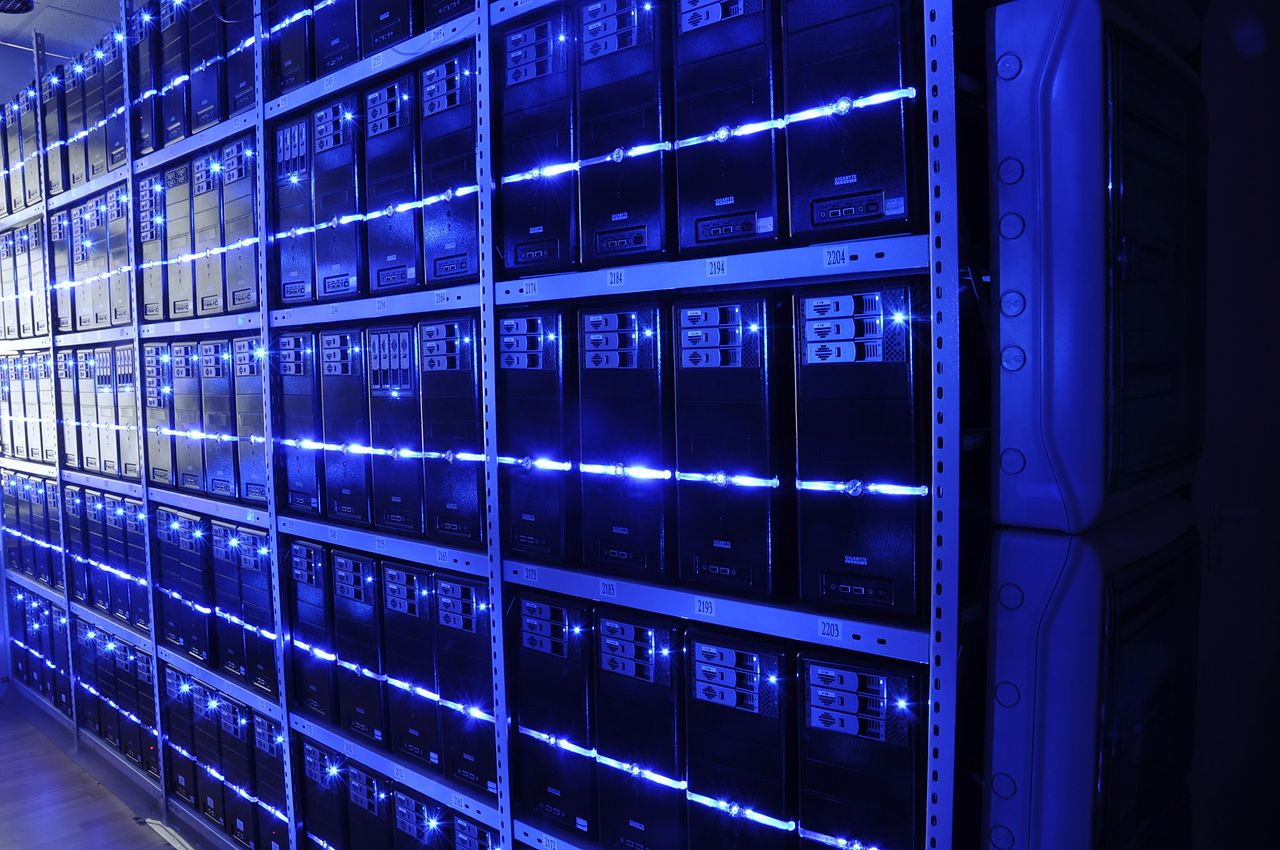
The brains are abundant now, and increasingly ours. Rows like this, on national compute, are the part India is already paying to build. The company worth starting is not another rack. It is what runs on top of all of them.
Server aisle in a data center. Photo: BalticServers.com, CC BY-SA 3.0, via Wikimedia Commons.
So build the operating layer
Picture what India should build instead. Not a model. A spine any model can plug into, that takes a hundred disconnected government systems and arrays them into one coordinated whole.
It is the operating layer for the Indian state. It sits on the sovereign brains and the India Stack substrate, turns the mess of government data into one live picture, and turns that picture into action with a record of why. Connect, model the world as an ontology, reason with citations, act, and audit. Start where the data is touchable and the stakes are real, and earn the harder rooms.
The hard parts are exactly those three problems, and there is no prompting your way through any of them. You build them, badly at first, then less badly, on real data, for years.
And you build it the way India built its best infrastructure. As a public good with an open spine, not a black box sold by the seat. Publish the shared vocabulary of the state like a protocol. Fund the layer and let founders build the apps. Keep it model-agnostic so no foreign lab and no single Indian one can hold it hostage. That is how UPI happened, and UPI is the most important thing India has shipped this century.
What it looks like when it works
Make it concrete. A cargo ship switches off its transponder near a stretch of seabed where a submarine cable runs. On its own, nothing. One vessel going dark is a Tuesday.

The Arabian Sea off India's west coast at night, from the International Space Station. Every cluster is a fishing fleet. The raw sensing already exists. The hard part was never seeing the lights. It was knowing which one just went dark, and what to do about it.
Night view from the International Space Station. Photo: NASA, public domain, via Wikimedia Commons.
Now give the watch a layer that sees. It already holds the ship's last position, its registry, its owner, the weather, and the track of every other hull in that water. It notices the gap, fuses a satellite pass to fix a position, and scores the behaviour against everything it knows. Loitering, over critical infrastructure, inside the exclusive economic zone. Not a hunch. A cited brief on the watch officer's screen in minutes, every line linked to the evidence underneath.
The officer decides. The nearest cutter gets a vector, the cable operator gets a warning, and the whole exchange writes itself into a record that will still make sense in a courtroom a year later.
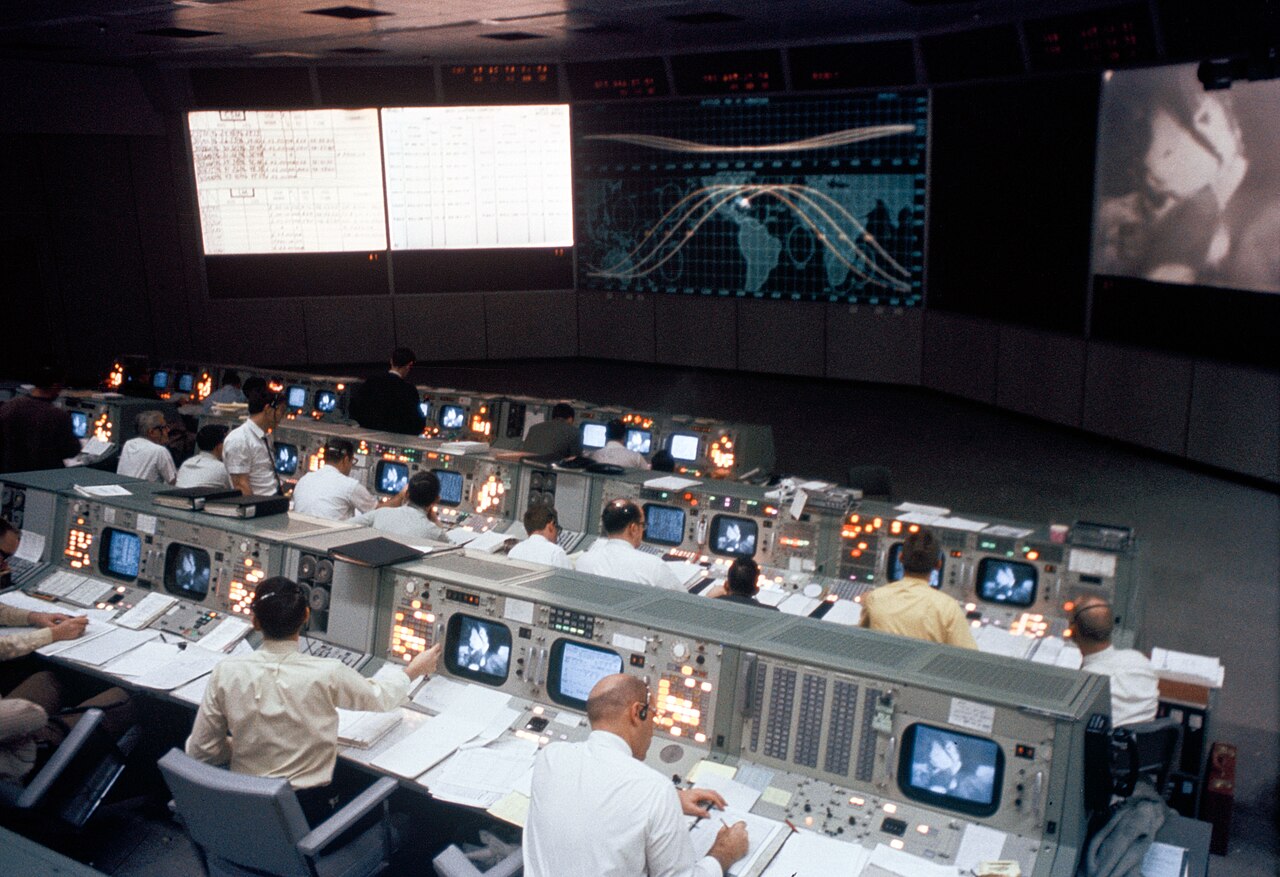
The whole point of the layer is this room, whatever you call it: one shared picture that turns scattered sensing into a single coordinated decision. A brain in a jar cannot build this room. It can only sit in it, once someone else has.
Mission control room. Photo: NASA, public domain, via Wikimedia Commons.
Not a step of that was a smarter model. It was the same cheap brain, wired into eyes, given hands, and held to account. The model could not have done any of it alone, and a year from now a better model still could not, because not one of those steps was ever about being smarter. They were about being connected, trusted, and allowed to act.
Why not the people you would expect
The obvious question is why this is not already built, by someone bigger. Walk the list.
The foreign operational-AI companies are real, and good, and structurally locked out of the part that matters. A country does not run its border on software that phones home to another country, and the moment a serious institution understands that, the foreignness stops being a detail and becomes the disqualification. A close ally learned this in public not long ago, and moved to tear up the contract.
The big system integrators have the relationships and the delivery muscle, and they build what you spec and lose interest the day they invoice. You get a system, delivered and frozen, not a thing that gets smarter every time the country uses it. Different species, and only one is a moat.
The model labs are brilliant at the brain and rightly uninterested in the body, because the body is a different company with a different metabolism. The lab ships weights. The layer ships a decade of resolved reality. Asking a model lab to also build the ontology of a state is asking a power station to wire every house.
The objection, taken seriously
The smartest version of the case against this deserves a real steelman.
The case is that building anything heavy right now is foolish, because AI is moving so fast that whatever you build is obsolete by launch. Better to stay light, wrap the latest model, and ride the curve.
It is good advice for a feature. It is exactly wrong for a moat.
The things a faster model obsoletes are the things that were just the model in a trench coat. The ontology of how a state works does not expire when the weights update. A decade of resolved entities does not reset. A trust layer a defence buyer has cleared does not need a rewrite because context windows grew. You are not racing the model. You are building the thing it plugs into, and the faster the curve, the more certain the bet.
The real risk is not that you are too early. It is that you wait, the layer gets built by someone, probably foreign, and India rents its own nervous system for the next fifty years. The short version of why that matters is plain. A country that cannot see itself on its own machine is not fully sovereign, and the window to fix that is now.
For a couple of years the model looked like the mountain. It was the foothill. The mountain is everything that has to be true for a model to act inside a real institution without lying, leaking, or forgetting, and it does not shrink as the models get better. It gets more valuable, and more clearly Indian.
The cheap thing is the brain. The hard thing, the scarce thing, the thing worth a decade, is the body built around it and the trust earned to let it act.
That is the company worth starting in India right now. Building it beats wrapping a model that is free by the time it ships.
Everyone is rushing to sell the shovel in a gold rush where the shovels are about to be free. The mine is the operating layer, the data is the ore, and the claim, for once, is India's to stake.
The brains get cheaper every quarter. The window is open now. The only question left is whether India builds the body, or rents it.