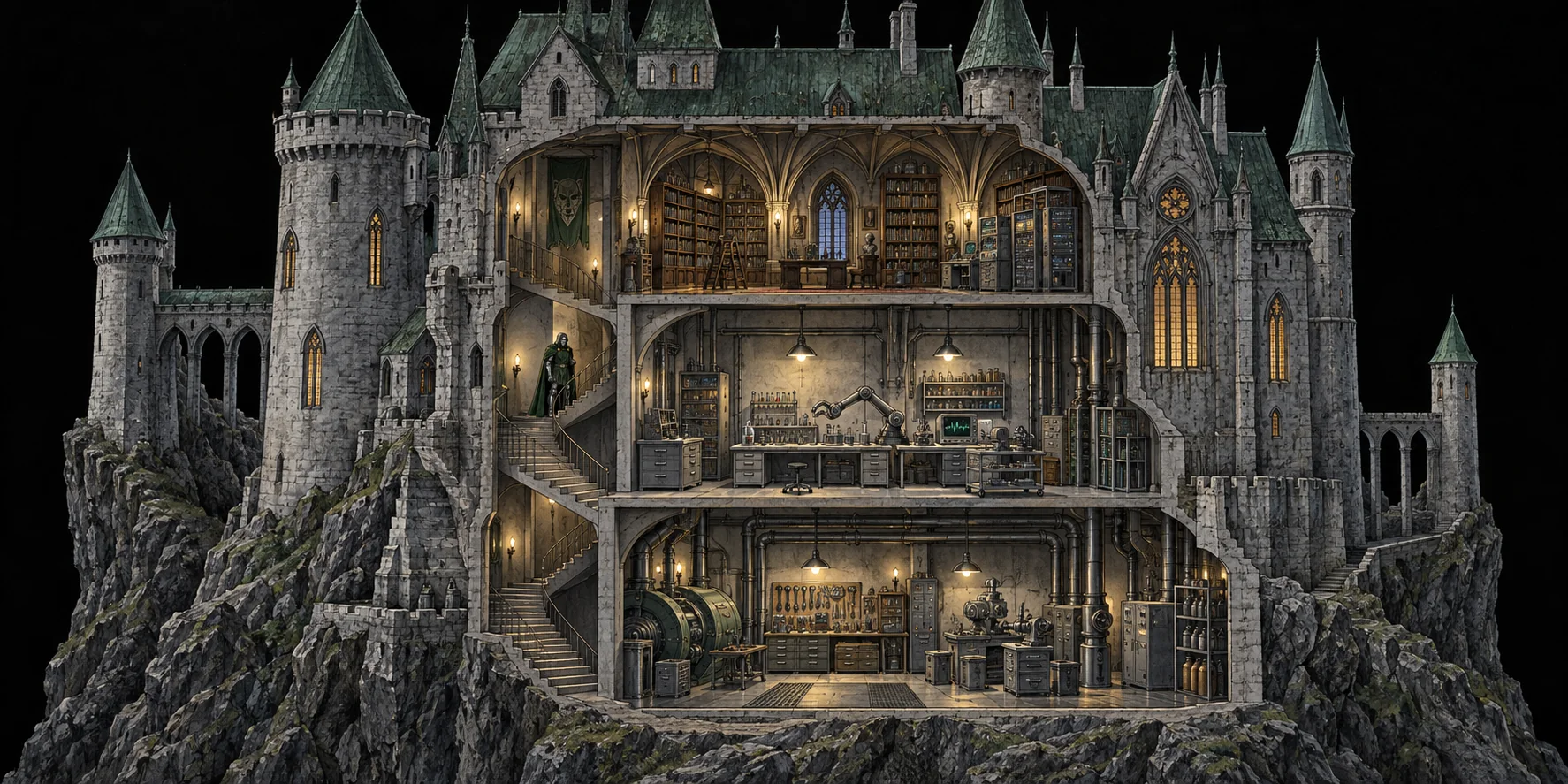
Before the armor
If I had to start becoming Doom in Bengaluru tomorrow, I would rent a small industrial room. I would not order armor.
The room would have one serious workstation, local storage, cameras, a robot arm, an electronics bench, a few instruments, good ventilation, and an unglamorous emergency stop. On day one it would look less like Castle Doom and more like a college lab that found funding.
That is fine. Doom's suit is only the last interface in a much larger system. Behind it sit memory, models, Doombots, fabrication, energy, a laboratory, and eventually a state. Victor can move from question to experiment to machine without waiting for five institutions to call him back.
He sees something, remembers everything relevant, forms a plan, acts through a machine, measures the result, and folds the failure back into himself. Science and magic are simply the two libraries he searches while doing this.
This is the order I would use. It gets surprisingly far with technology that exists now. It also makes the impossible parts much easier to see.
Build the mask. Keep the compute off your face.
The first Doom machine should be a private context system worn near the senses. Glasses, a clip, an earpiece, or some combination of them can capture what Victor sees and hears. The heavy compute can stay on a phone, a nearby edge box, or a private server. A helmet running a hot GPU beside the skull is a short experiment.
The pipeline is straightforward to draw and difficult to make trustworthy. Wake detection and voice activity detection happen locally. Speech and vision are converted into usable events. Identity and consent rules decide what may continue. The useful parts become memories in an encrypted index. Raw audio disappears unless the wearer explicitly keeps it.
A memory needs a reason to stay.
- INA signalSpeech or vision near the wearer.
- GATEPermission & relevanceDecide what can enter the index.
- KEEPUsable contextA memory linked to its source.
Discard the raw capture. Retain it only through an explicit choice.
Then retrieval has to work. When Victor opens a machine, the mask should find the relevant schematic, the last failed test, and the promise he made to the person waiting for it. It should not surface a vaguely similar dinner conversation with great confidence.
I work on this problem at NeoSapien. Transcription is the visible part. Most of my attention goes into deciding what deserves to become memory, how long it should live, and when the system should remain silent. A mask that remembers everything would be unbearable. Doom needs selective memory, not surveillance with cheekbones.
“Doom does nothing halfway.”
Doctor Doom, Blood Hunt #5, 2024
I would test the mask on four numbers: wrong memories retrieved, useful memories missed, response time, and minutes of raw data retained. The last number should usually be zero.
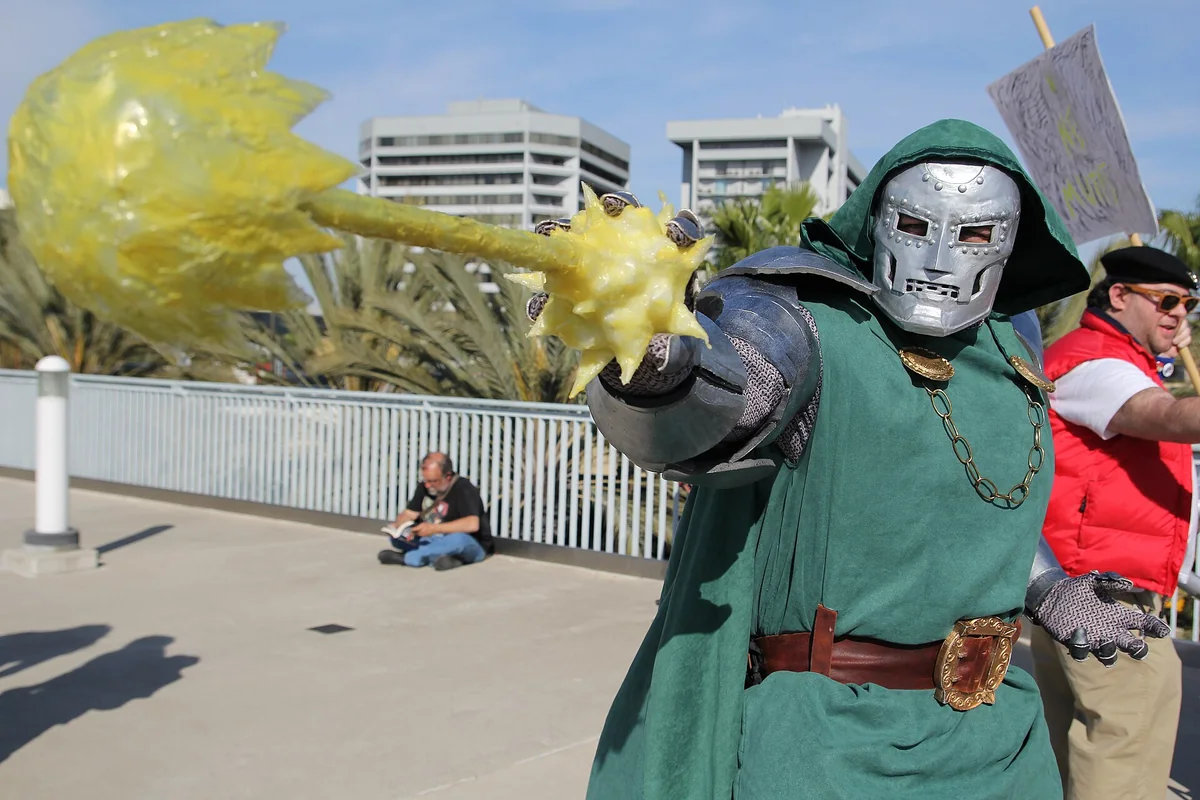
Everything arrives
through the mask.
The comic gives Victor perception, computation and sorcery in one object. The engineering problem is deciding which of those jobs should happen somewhere else.
William Tung · WonderCon 2019 ↗
Doom is a closed loop
The mask notices. Memory restores context. An agent chooses a bounded action. A robot performs it. The lab measures what happened.
The result has to come back.
- 01NoticeA test needs repeating.
- 02RecallFind the previous run.
- 03ChooseSelect an allowed action.
- 04ActMove a sample into place.
- 05MeasureRecord what happened.
- 06UpdateCarry the result forward.
Follow a sample from a question to a recorded failure.
That chain is the practical Doom stack. The castle supplies compute, power, tools, replacement parts, and a place for the failures to accumulate without becoming folklore.
Each link exists today in a weak form. The mask misses context. The agent invents a fact. The robot drops a connector. The instrument drifts. The generator trips. Doom begins when these failures are visible to the next run instead of hidden by the demo.
I care about shortening the path from observation to verified action. Autonomy is useful only where it helps that path.
The first Doombot should never leave the computer
I would give one agent a narrow job inside a sandbox. Maintain a codebase. Track a test rig. Read a fixed set of papers and reproduce one result. It gets explicit tools, a small budget, an action log, and no authority to approve its own work.
The loop is goal, plan, tool call, observation, verification, memory. The verification step matters most. A second model can attack the result, but a real test, compiler, sensor, or human approval should close the action. Two agents agreeing with each other is not evidence. Sometimes it is just a meeting.
The agent cannot sign its own receipt.
One job. Named tools. A fixed budget.
A test, an instrument, or a person with authority.
PASS Accept the result with its evidence.
FAIL Keep the failure. Stop or revise.
Only after that works would I give the Doombot hands. Start with a robot arm on a fixed bench, two cameras, force limits, and an emergency stop. Teleoperate it through one useful task, record the episodes, train a policy, and test it across changed lighting, misplaced objects, and interrupted runs.
LeRobot already provides this basic path from teleoperation and dataset recording to policy training and real-robot evaluation. V-JEPA 2 shows how a model trained largely from video can be adapted to predict and plan physical actions. NVIDIA's GR00T and Cosmos tools push the same direction through vision-language-action models, simulation, and synthetic trajectories.
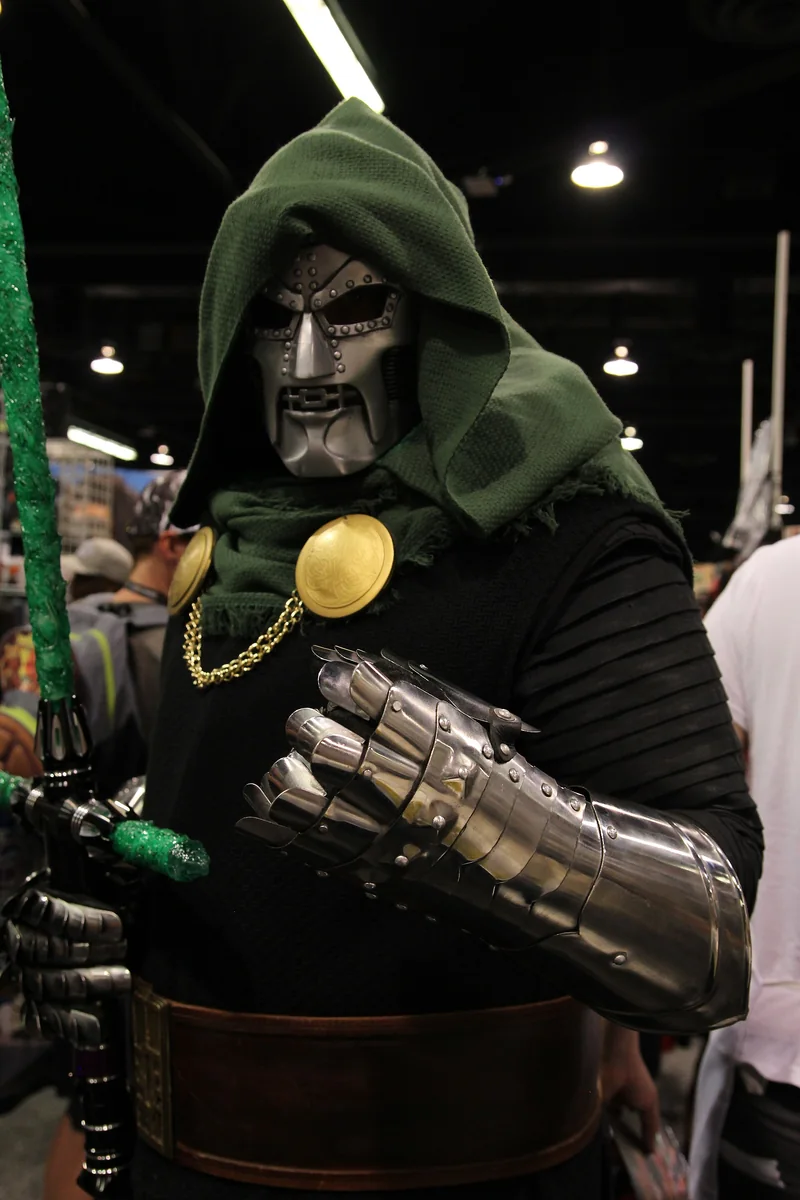
A second Victor.
William Tung · WonderCon 2017 ↗
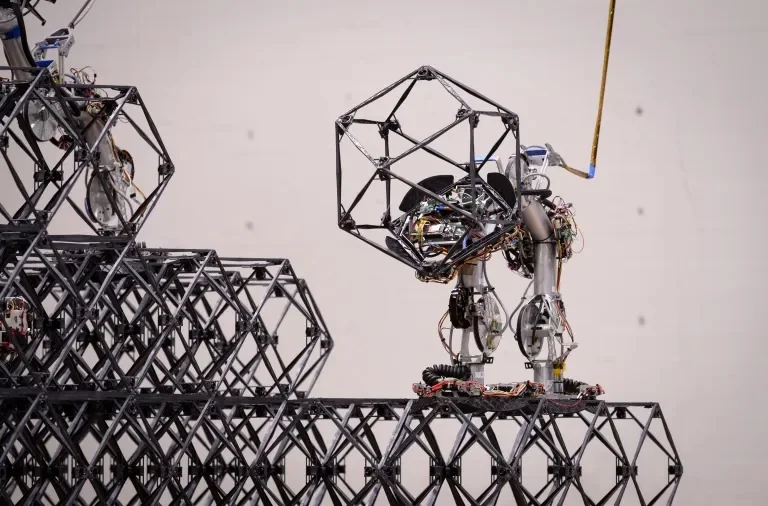
One block at a time.
NASA’s ARMADAS demonstration used robots that move across a lattice and assemble its building blocks. The environment is designed around the machine’s task. That is a useful place to start.
NASA / Dominic Hart ↗None of them gives you a general Doombot. They give you better starting points for a bounded robot skill.
I would track task success, human interventions, resets per hour, and damage. Nine successful runs do not make up for destroying the fixture on the tenth. Count the damage.
A Doombot without a receipt is Victor's confidence with an API.
Make one experiment close its own loop
The laboratory is Doom's real superpower. I would begin with materials, electronics, or mechanical testing, not biology. The experiment needs to be safe enough to repeat and boring enough that nobody is tempted to edit the failure out of the video.
Connect the instruments to a common event log. Give every sample an identity. Let the robot move it. Let software run the measurement and attach the raw result. A model can suggest the next parameter, but a human approves the operating envelope and the machine enforces it.
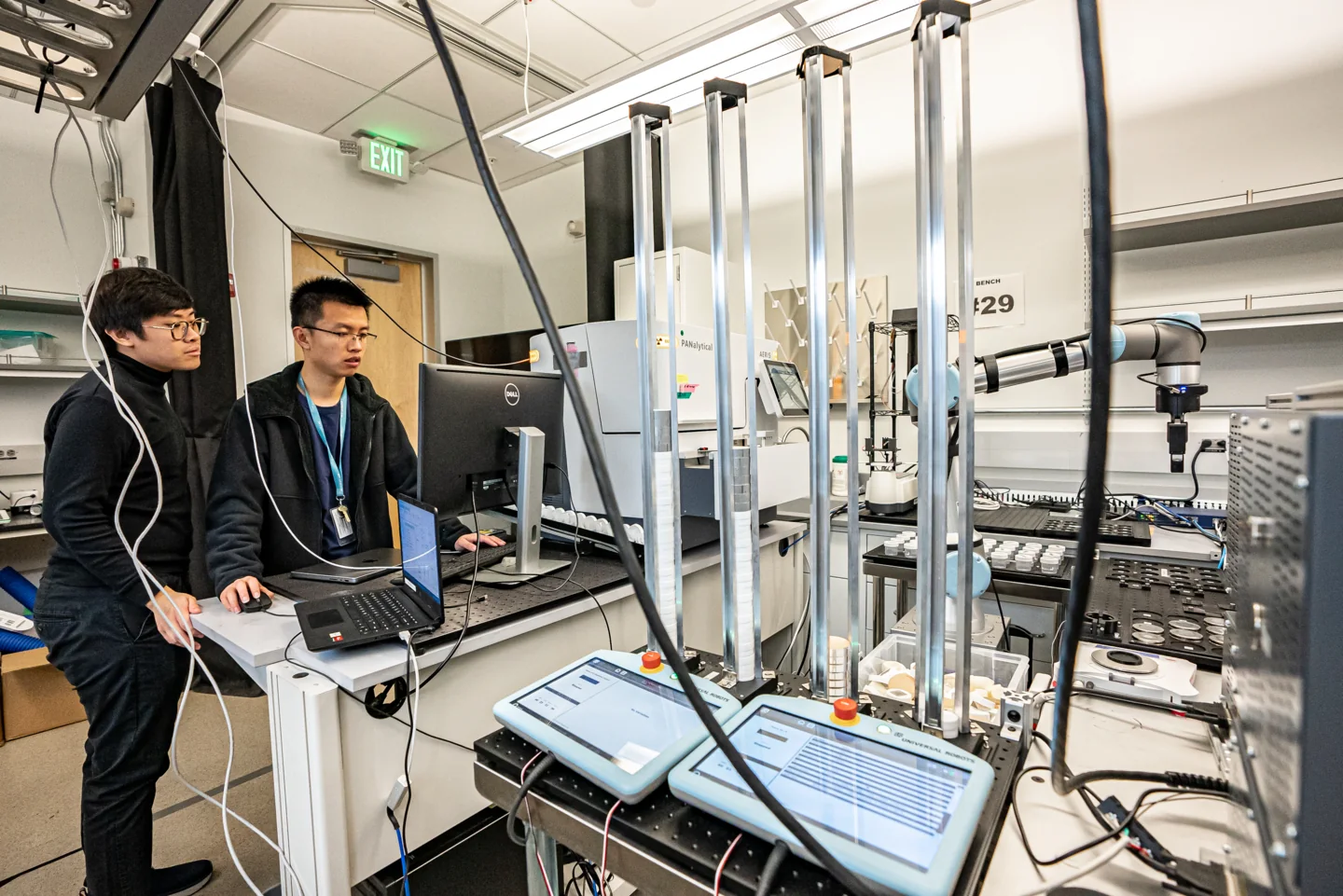
A real room where robots, materials synthesis and measurements belong to the same workflow. The surrounding instruments matter as much as the arm.
Marilyn Sargent / Berkeley Lab ↗The Department of Energy describes autonomous laboratories in almost exactly this shape: robotics, edge AI, real-time analysis, feedback, hypothesis generation, and data curation inside one experimental workflow. Doom's version would add fabrication, so the room can make a new fixture when the old one becomes the bottleneck.
I would track the hours from a question to a reproduced measurement. Someone else should be able to run the experiment again, with the same sample record and the same procedure.
The lab becomes intelligent when failure automatically changes the next experiment.
Give the failure a place in the record.
Attempt the testUse a named sample and procedure.
The fixture slipsThe measurement is not accepted.
Inspect the clampResolve the cause before another run.
{
  "run": 42,
  "sample": "coupon_07",
  "outcome": "fixture_slipped",
  "measurement_valid": false,
  "next": "inspect_clamp"
}Leave the armor until the workshop works
A plausible first suit is protective equipment with sensing, communication, environmental monitoring, and modest powered assistance. It does not fly. It does not stop artillery. It should fail into a state the wearer can climb out of.
The compute mostly stays elsewhere. Jetson Thor can carry 128 GB of memory and run at 40 to 130 watts, which is remarkable for a robot and awkward for a helmet. Add batteries, motors, cooling, and impact protection and the costume becomes a thermal engineering problem with a person trapped inside it.
So the suit remains a terminal. It sends sensor data to the nearby edge system, receives a small amount of useful context, controls tools, and keeps Victor alive. The castle does the heavy thinking.
Compact flight armor, reliable mind reading, biological immortality, time travel, and reality editing remain fiction. Better batteries and actuators will improve the suit. They do not repeal heat, mass, or impact.
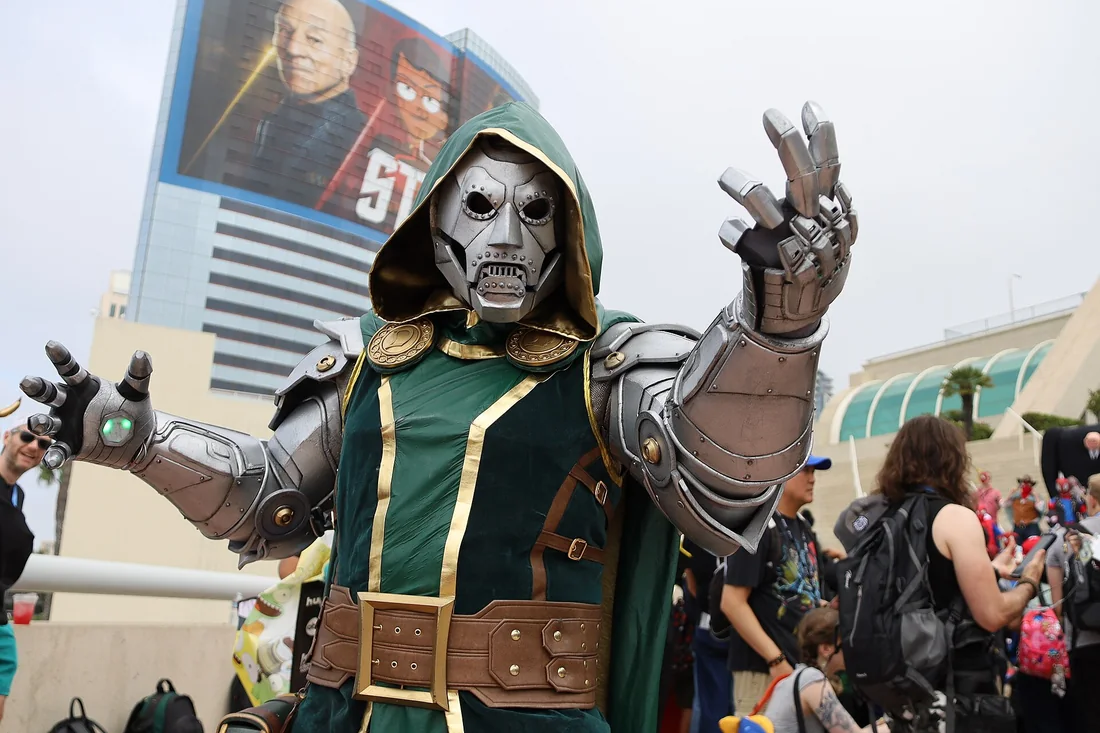
The suit is
a terminal.
- On youSenses & controlsCapture, display, physical protection.
- Near youFast local decisionsAn edge box for sensitive or urgent work.
- In the roomHeavy computationStorage, models, cooling and power.

Keep the altar. Remove the superstition.
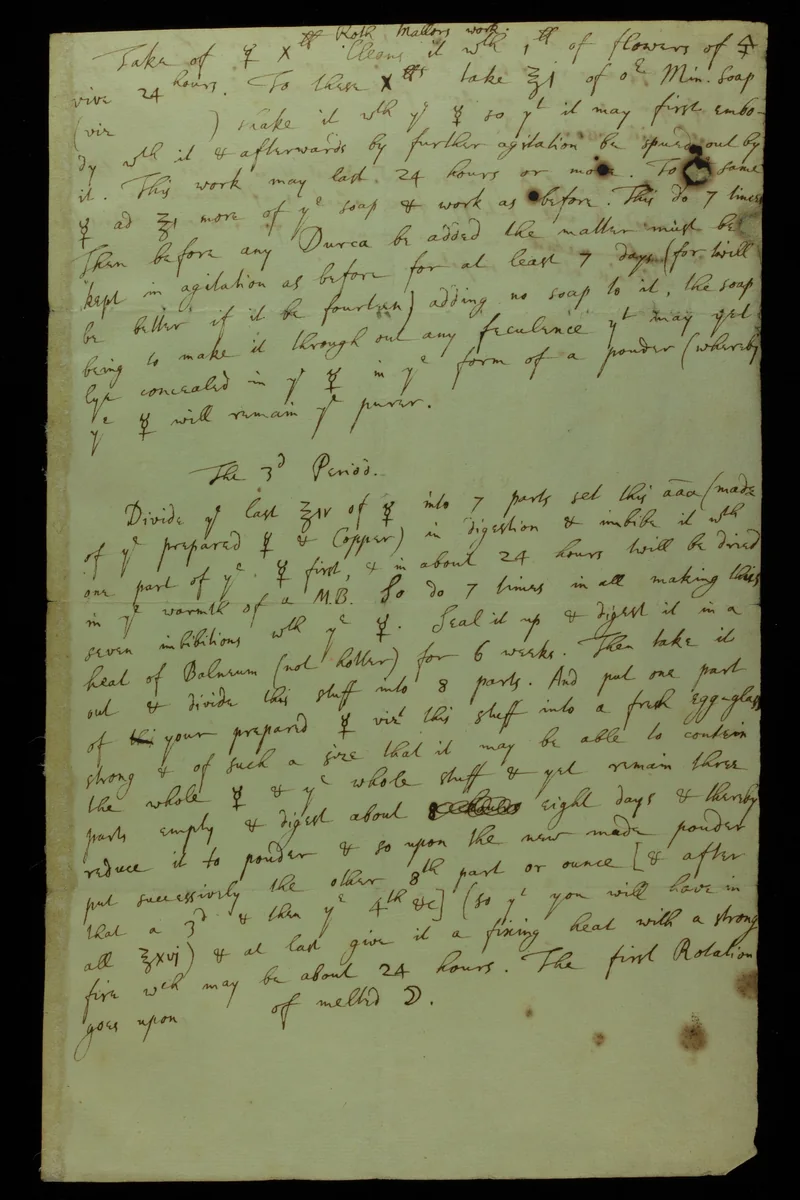
Newton kept
alchemy notes.
This page records material drawn from the alchemist Erasmus Rothmaler. It is a trace of what Newton investigated, not evidence that the process worked.
Science History Institute ↗.jpg)
Magic is literal in Marvel. Doom studies spells because spells work. In our world, there is no credible evidence that an incantation opens a dimension or bargains with a soul. Calling quantum mechanics “magic” does not help. It usually means somebody stopped reading early.
There are still technologies that cross boundaries which used to feel absolute. An implanted brain-computer interface has let a man with paralysis speak at home through a synthesised version of his voice. Casgevy edits a patient's own blood stem cells as a treatment for sickle cell disease and transfusion-dependent beta-thalassemia. Quantum sensors can detect tiny changes in time, gravity, and magnetic fields.
Treat them as narrow systems built through measurement, clinical evidence, and years of work. None provides telepathy, enhancement, or sorcery. That narrowness is important.
The altar has another use. Doom trains his attention as seriously as his machines. I would keep a place in the castle for meditation, breath, memory, and long thought. Not because the mind can bend matter, but because a distracted operator can waste a laboratory faster than any failed model.
Castle Doom starts as control over dependencies
Once the mask, Doombot, and laboratory work separately, I would bring them onto one site. Local compute. Encrypted storage. A fabrication room. A robot cell. Instruments. Spares. Grid power with batteries and generation where it makes sense. Enough networking to coordinate the system, and enough isolation that an internet outage does not erase Victor's brain.
Castle Doom means being able to keep learning, making, and repairing without begging a different vendor at every step. A rich person can buy one impressive machine. Doom owns the path that produces the next one.
This is also where the solo-genius fantasy ends. The real castle needs a roboticist, machinist, model engineer, scientist, safety lead, and someone who understands law and consent. Victor's habit of making himself the final reviewer of everything would turn the whole place into a very expensive queue.
In Blood Hunt #5, after Doctor Strange gives Doom the Sorcerer Supreme mantle to help stop a vampire crisis, Victor refuses to return it:
“Let me show you what it means to save the world.”
Doctor Doom, Blood Hunt #5, 2024
That sentence contains the flaw in the design. Doom always turns capability into jurisdiction. A serious Castle Doom would need signed actions, visible logs, hard spending limits, independent safety controls, and people who can stop Victor. Otherwise the most advanced system in the building is still one man's mood.
A country is not the next product feature. The useful target is smaller: a private institution that can remember, reason, build, test, and repair while remaining answerable to the people around it.
God Emperor is not an engineering milestone
Doom once tells Valeria Richards something only Doom could say:
“I was a god, Valeria. I found it... beneath me.”
Doctor Doom, Fantastic Four #611, 2012
It is half boast and half cover story. When the multiverse collapses in Secret Wars (2015), Victor takes the Beyonders' power, stitches Battleworld together from the remains, installs a court, and calls himself God Emperor.
Then we learn where the electricity comes from.
Owen Reece, the Molecule Man, sits beneath the system as the reservoir holding Doom's world together. Reed Richards eventually finds the dependency hidden under the throne.
Follow the power one level further.
What does the whole system stop without?
- The power connection.
- The part only one supplier makes.
- The person who knows how to restart it.
Doom was emperor. Owen Reece was the power station.
Current technology offers no route to rewriting reality, reviving the dead at will, or holding a universe together with thought. The closest human analogue is control over energy, compute, fabrication, medicine, communications, and law. Call it infrastructure monopoly, not godhood. It is a terrible design goal.
Every castle has an Owen Reece somewhere. A supplier. A grid connection. A model it cannot reproduce. A person who remembers how the machine was assembled. The manual is incomplete until that dependency is visible.
Start with one closed loop
- Monday: put a private memory system on one workstation. Feed it only data you have the right to use. Make it retrieve the correct context for one recurring technical task.
- When retrieval works: give one agent a sandbox and one tool. Make every action inspectable. Do not add a second agent until the first can finish useful work without inventing the receipt.
- When the software is boring: place a robot arm on a bench. Teleoperate one task, train it, disturb the environment, and count every intervention. Connect one instrument only after the physical loop is boring.
- When the bench closes its loop: shorten the path from failed measurement to the next run. Add fabrication when replacement parts become the delay. Add edge compute when latency or privacy requires it. Add wearable interfaces when the room already knows what useful context looks like.
- Before scaling: build the team and rules that let the system disagree with its owner. Doom's technical range is worth copying. His need to be the only mind in the room is not.
That is as close as I know how to get: a mask that remembers selectively, a Doombot that can show its work, and a laboratory that learns from contact with matter. The castle grows around that loop.
The cloak can wait.