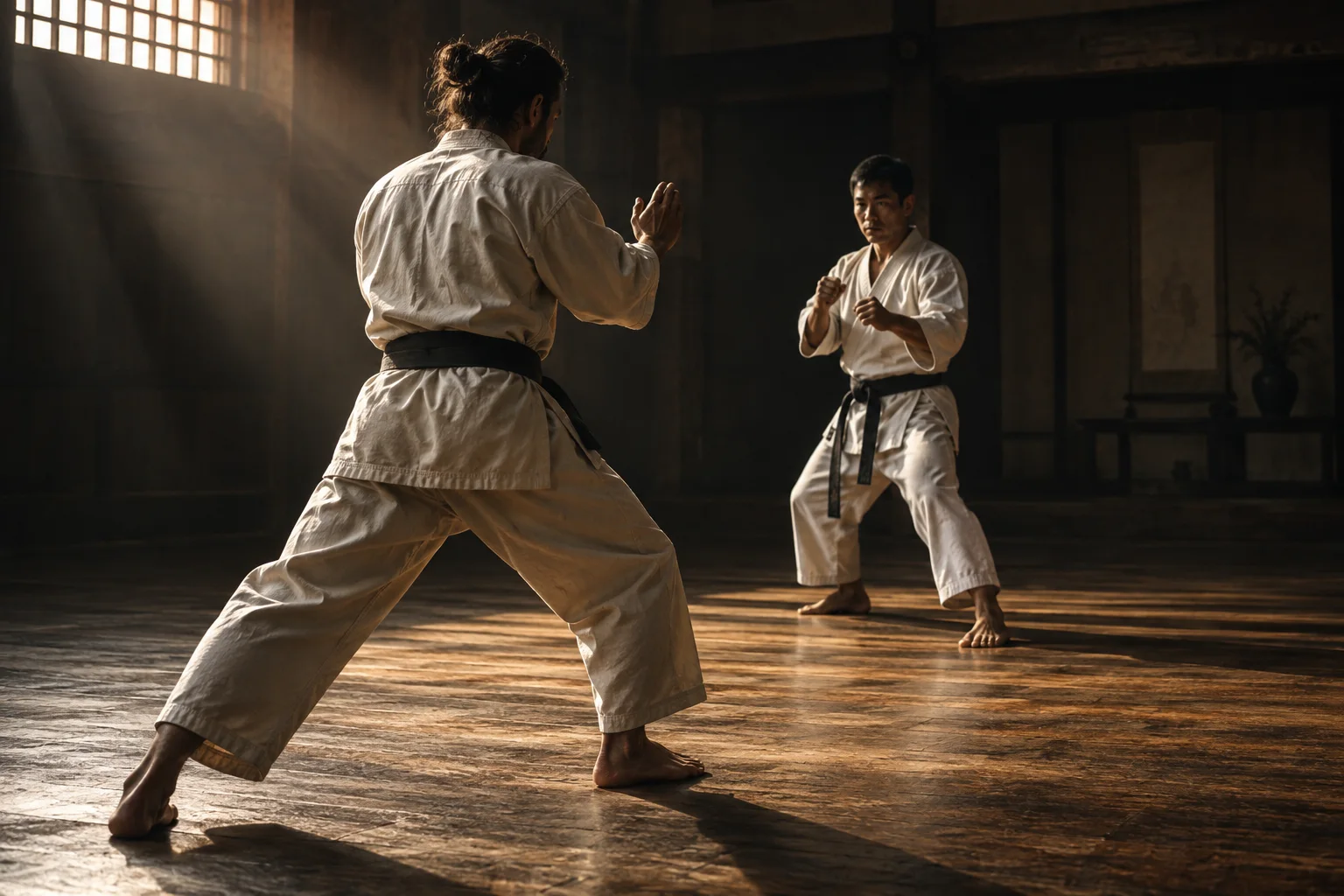
I know how to push. Engineering, karate and building a company have all given me practice at it. I understand the appeal of a hard problem you can meet with more effort: stay longer, try again, get better, refuse to leave it broken.
For a long time, I thought that was most of the work.
Building NeoSapien made the limit harder to ignore. A company needs people who will act before the situation feels safe. It also needs someone to notice when the push is making things worse. You can get the fix out tonight and still leave behind a team that is less willing to tell you what is wrong tomorrow.
The warrior and the king are the names I use for those two responsibilities. The warrior confronts the problem. The king thinks about everyone who has to live with the response. I am using a metaphor here, not proposing a theory of personality or giving founders a royal title. The people around you are colleagues, not subjects.
What interests me is the moment when both responsibilities belong to the same person.
Meet the problem.
Decide. Confront. Do the difficult work.
Consider what follows.
Protect. Sequence. Make room for others.
What force is for
I am a karate black belt and have competed at the national level. That gives me a fairly literal relationship with the word warrior. Even so, the part of martial arts that matters to this essay is control: distance, timing, being able to commit to a movement without losing your balance.
More effort does not automatically improve a badly timed action. In a company, it can make the consequences larger. More messages, more escalation, more people pulled into a problem whose owner has barely had time to examine it.
There is necessary force, too. A recurring quality issue needs to be named. A commitment cannot become optional because the conversation about it is uncomfortable. Someone has to decide what is good enough to reach a user, then hold that line when a deadline starts moving closer.
Consider a release that repeats a known bug. This is an example, not a reconstruction of one particular incident. The immediate job is to understand the impact, contain it and get a fix owned. Later, there is a different job: find out how it passed through the release process again. A speech about caring more can leave both jobs undone.
I still get angry when the same bug returns. Anger can tell me something matters. It cannot tell me whether the cause was an unclear requirement, a missing check, a decision I rushed, or somebody failing to do what they agreed to do. Those explanations call for different responses.
Separate the event
from the first explanation.
- ObservedThe known bug returned.
Establish impact and contain it.
- Interpretation“They don't care.”
A thought to examine, not an established cause.
- InquiryHow did it get through?
Requirement, check, decision or follow-through?
- ResponseFix the cause.
Name the owner, the change and the check.
Contain active harm first. Inquiry informs the lasting fix.
Holding a standard includes being willing to find my own decision in the chain of causes. Otherwise “accountability” becomes a demand I make of everyone else.
The work that has to outlast me
The king's work is less immediately satisfying. You do not always get the relief of personally unblocking something. Sometimes you have to leave enough room for another person to think, recommend a course of action, and carry it through.
That can feel slow when you already have an answer.
But there is a cost to making yourself the answer every time. People can learn that the safest thing to do is wait for you. Then the waiting looks like a lack of initiative, so you intervene more often. It is possible to be working very hard at maintaining a dependency you dislike.
What I want instead is specific. Someone owns the decision. They know what outcome matters and which constraints they cannot cross. They know when to bring it back, and what evidence would count as finished. I still have a responsibility to notice when it is going wrong. I do not need to occupy every step in between.
Clear escalation points. Enough authority to act between them.
This changes what a good day looks like. Sometimes it is the day a difficult thing shipped. Sometimes it is the day another person made a sound decision without needing my version first. The second result is easier to overlook because there may be nothing dramatic for me to do.
The same judgment applies to urgency. A customer losing access and a slide looking unfinished should not receive the same response. If everything gets the language of an emergency, people have to infer the real priorities from tone, repetition and how late the messages arrive. I would rather state what matters and what can wait.
A little space before the reaction
There was a period near the end of college when I went through an existential collapse. Depression. Suicidal thoughts. I was struggling with whether any of this meant anything at all.
That experience pushed me towards Buddhism and then deeper into Advaita Vedanta. These questions were personal long before they were useful to my work.
Advaita gave me a way to question the identification with each thought, mood, success or failure. Its claim about the self is more radical than “take a breath and calm down”: it identifies ātman with brahman. Buddhist accounts of no-self take a different philosophical position. I do not think it helps to turn them into two versions of the same productivity technique. On Śaṅkara ↗ · Buddhist no-self ↗
What I carry into an ordinary difficult day is smaller. The reaction still happens. I can notice it before treating it as the only possible account of what happened. “The product failed” and “I am a failure” feel close together when I care deeply about the work. They are still different statements.
This does not settle the product problem. It gives me a better chance of looking at it.
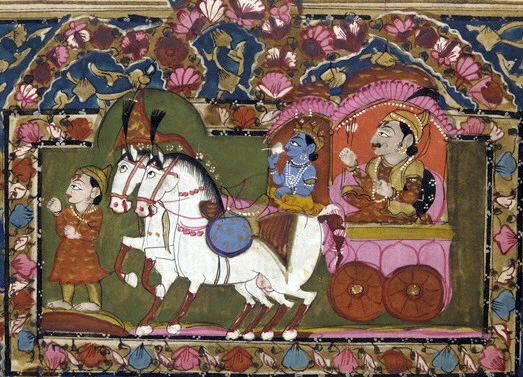
Krishna and Arjuna
on the chariot.
The Gita’s conversation takes place before battle. Its questions about action carry moral stakes beyond the workplace analogy.
Anonymous · India · 18th to 19th centuryPublic domain, via Wikimedia Commons ↗
I also return to the tension in the Bhagavad Gita: act, while loosening attachment to the result. Verse 2.47 pairs its teaching about action and its fruits with a warning against attachment to inaction. Verse 2.48 asks for equanimity in success and failure. That second half matters to me. Detachment is easy to praise when it excuses withdrawing from a difficult situation. 2.47 ↗ · 2.48 ↗
I read this as a demand to remain involved without making the outcome the whole measure of my worth. That is my application to work, not a claim that the Gita is a startup manual. Its setting is a war, and the moral difficulty of that setting should survive any convenient analogy we take from it.
A missed target still needs explaining. A customer still deserves a working product. There are consequences to a bad decision even if I manage to feel peaceful about it.
What I am willing to trade
One useful test comes before a deadline: what am I prepared to move, and what am I about to spend without admitting it?
Scope can move. A date can sometimes move. The order of work can change. Those are real choices, with costs that should be made explicit. Relationships and health also pay for decisions, but their cost is often absent from the plan. You can keep a date on the calendar by moving the damage somewhere nobody is measuring.
I used to describe this in three rings: sacred, important, negotiable. I still find the distinction useful, though the categories are not always clean. Quality, for example, contains both essential protections and details that can improve after release. Calling everything sacred makes the word useless.
People, honesty, essential safeguards.
A deadline cannot make a known serious harm acceptable.
The quality bar for this release.
Separate what users need to rely on from what can improve later.
Scope, sequence, sometimes the date.
Name the cost of the change and who will carry it.
The point is to say the trade aloud before everyone is tired. Which promise are we keeping? Which part of the scope can wait? Who is absorbing the extra work? What happens if we discover that the current plan cannot meet the standard?
Some questions I would like to answer more honestly:
- Am I asking for speed because the situation needs it, or because waiting makes me uncomfortable?
- Have I made the decision clear enough for someone else to own it?
- Would I accept this trade if I were the person carrying its cost?
- What changes after this incident so that the next one needs less intervention?
These are useful only if the answer can change what I do. Otherwise they become a more elaborate way of approving the decision I had already made.

I do not say any of this from a place of mastery. This is one of the areas where my values and behaviour still argue with each other.
The warrior part comes readily to me. I can recognise the problem, get involved and push. The harder practice is to ask what that involvement leaves behind: a better decision, someone more capable, a problem less likely to return. Or simply another evening in which everyone waited for me.
I want to keep the part that refuses to leave things broken. I also want to get better at knowing when to step back and let someone else do the work.