The Money
Goes in a Circle
A serpent eating its own tail is not a market. Notes on circular financing, a product that loses money every time it sells, the Chinese models giving it away for free, and why the bubble and the railroad might be the same event.
A dollar leaves one company, passes through three others, and comes back looking like twenty. Nobody printed anything. Nobody lied, exactly. The dollar just went around the ring enough times that everyone it touched could book it as revenue, or investment, or a partnership worth announcing. This is the quiet engine humming under the AI boom, and once you have seen it you cannot stop seeing it.
I want to be careful here, because there are two easy positions and both are lazy. One is that the whole thing is a fraud about to collapse and take your job with it. The other is that this is the most important technology since electricity and anyone counting the money is missing the point. I do not believe either.
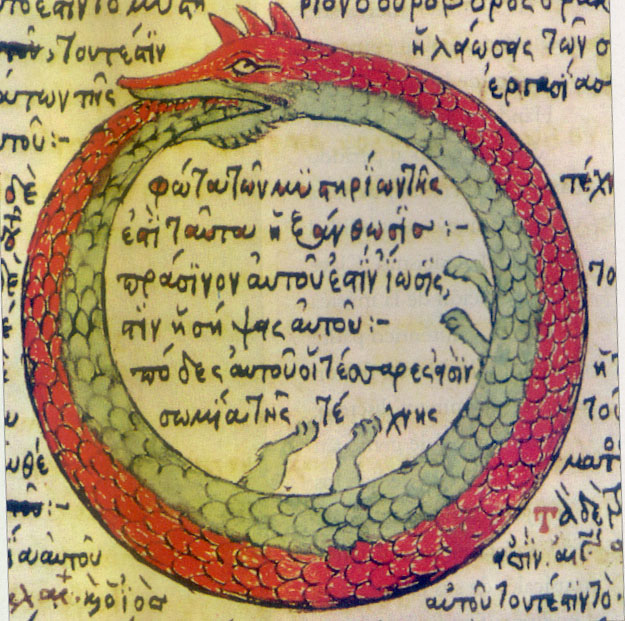
I build with this technology every day and I think it is real. I also think the way it is being financed, priced, and defended has started to look less like an industry and more like a shape from an old woodcut.
So let me walk through what actually bothers me, in the order a good video essay laid it out, with the numbers attached. Three problems. Nobody trusts the product. The unit economics are broken in a way we have never seen from software. And the world, it turns out, has another option. Then the thing that talked me halfway back off the ledge.
The bull case and the bear case agree on almost all of the facts and split on a single word. The bears say bubble. The builders say infrastructure. The strange part is that both are usually right at the same time, and the history of manias is mostly the story of what got left standing after the money burned.
The dollar that becomes twenty
Start with the circle, because it is the part that reads like a magic trick.
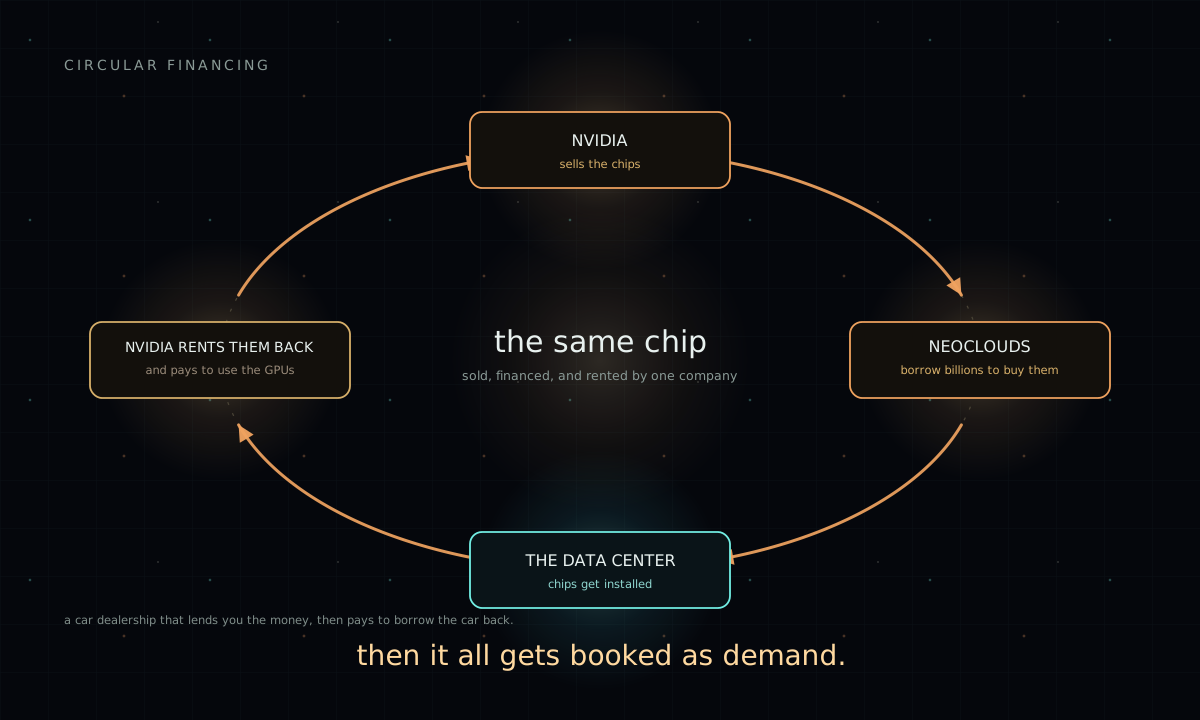
Nvidia sells its chips to a cluster of smaller cloud companies, the ones people have started calling NeoClouds. Those companies borrow billions of dollars to buy the chips. Then, according to reporting, Nvidia turns around and rents the same chips back, paying the NeoClouds to host the GPUs it just sold them. The money goes out as a sale and comes home as a rental, and both ends get counted.
One critic described it as a car dealership that lends you the money to buy the car, then pays you to borrow the car back for the weekend, and reports every leg of that as demand. Now look how much demand we have.
Oracle is the version that made me sit up. Its own annual report says it is building 7.1 gigawatts of capacity, several nuclear power plants' worth of electricity, for essentially one customer, and lists as a real risk that it might not get paid.
That customer is widely understood to be OpenAI, which lost around twenty billion dollars last year. The writer Ed Zitron estimates OpenAI would owe something like seventy-five billion dollars a year in compute for the full Stargate buildout, which is money it does not have.
So the counterparty holding up one of the largest infrastructure bets in history is a company that loses tens of billions a year, and everyone in the chain is quietly aware of it.
I cannot prove the exact multiple of how many times a single dollar gets counted as it travels around this ring. I would not repeat a number I cannot stand behind. But the shape is not in dispute, because the companies drew it themselves, in their own filings.
There is a name for an industry that starts buying back its own equipment and calling it growth, and the name is not enough real customers.
The restaurant that loses money
The circle would be survivable if the thing it funds were a normal software business. It is not, and that is the part that genuinely surprised me.
Software has been the best business ever invented for one reason. You spend a lot of money building the thing once, and then every new customer is almost free. Microsoft does not spend anything extra to sell you one more copy of Excel.
Its cost stays flat while its revenue climbs, and the widening gap between those two lines is pure profit. That gap is why software companies became the most valuable companies on Earth.
AI broke that model. Every single time you ask a chatbot a question, it costs the company real money, because the query burns electricity and wears the chips down. More customers does not mean more free money anymore. More customers means more cost, dollar for dollar.
So this is not a software business. It is closer to a restaurant, one that has to buy the ingredients for every meal it serves, except this restaurant loses money on every plate and its plan to fix that is to serve more plates.
Put a number on it. OpenAI burned through about twenty billion dollars in a single year, on audited financials reported by the Financial Times. For twenty-five years investors have been trained to be patient with numbers like that, because Amazon lost money for years before its margins bloomed.
But here the margins are going the wrong way. Each new model costs more to run than the last one, so the two lines, cost and revenue, keep climbing together and the gap that is supposed to become profit never really opens. There is, so far, no proof it ever will.
A technology can be genuinely miraculous and a genuinely terrible business at the same time. The two facts do not cancel. They just have different clocks.
Why won't they charge for the result?
Here is the question that reframed the whole thing for me, and it came from Alex Karp, of all people, the head of Palantir.
You pay a lawyer to win the case. You pay a contractor to remodel the kitchen. The price is attached to a result. AI does not work that way. It charges you per token, a fraction of a cent for every word it reads and every word it writes, whether the answer was brilliant or was garbage.
If the technology were really worth what the marketing claims, the sales pitch would be the easiest in history. Pay us nothing unless we make you money, and give us a cut when we build you a business. Nobody is offering that deal.
Part of the reason is that the models hallucinate, confidently inventing things in ways that even the people who built them cannot fully predict or prevent, so no vendor can honestly promise the outcome.
And there is a deeper fear underneath, the one that actually keeps enterprise buyers up at night. When your company runs its work through someone else's model, your data flows through that model. Your process, your trade secrets, the special sauce Karp calls your alpha.
So what happens when the AI company learns from your business? It can quietly become your competitor. This is not hypothetical. Anthropic launched a design tool while it had a working relationship with Figma, a design company, and Figma's chief executive said publicly that he was shocked.
Picture paying a vendor millions a year and using that money to train your own replacement.
Which is why the most technical buyers have all started saying the same thing. I want to own it. Own the chips, own the data, own the model, control the weights.
Instead of renting intelligence from someone who can read your inputs and, in principle, switch you off, you download a model and run it on your own machines, where nobody can watch it and nobody can turn it off.
The video that set me down this path opened with a harder version of the same fear, a claim that the United States government had ordered one AI lab to cut its most powerful models off from foreign nationals, and that European governments began dropping American AI vendors in response, because you cannot build on a partner who is able to turn off the tap. I cannot verify every specific in that story and I will not pretend to.
But the fear it names is real, and it points in exactly the same direction. If the thing is rented, it can be revoked.
I feel the pull of this personally. Everything I have ever built works better when the person using it owns the thing, rather than renting it from someone who can watch over their shoulder and change the terms. That instinct is about to matter, because it turns out there is somewhere to go.
The world has another option
The entire American story rests on one assumption. When the profits finally arrive, and maybe they will, US companies will collect them, because the world has no other choice. The third problem is that the world does have another choice. It is called China.
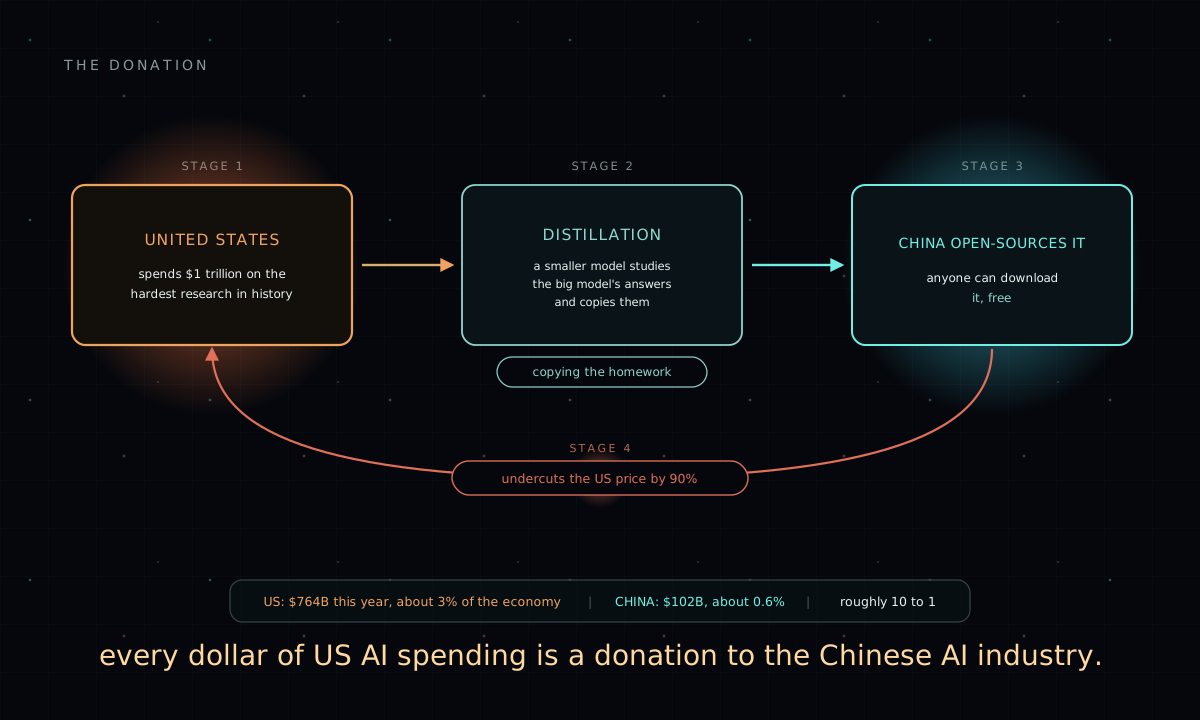
Look at the spending first, because the shape of it is not what you would guess. America is putting somewhere around 764 billion dollars into AI this year, on its way to a trillion, close to three percent of the entire US economy. China is spending roughly 102 billion, about six tenths of one percent of its economy.
America is outspending China nearly ten to one. And it is not obviously winning.
The way China does more with far less is a technique called distillation. Training a frontier model from scratch means spending billions to teach it everything the hard way. But you can train a new model by studying the answers of one that already exists, close to copying someone else's homework and arriving at the answer for almost nothing.
So the United States does the hardest and most expensive research in human history, and China compresses the results into smaller, cheaper models and gives them away, open-sourced, free for anyone to download. Seen from that angle, every dollar of American AI spending is partly a donation to the Chinese AI industry.
The quality gap is a lot smaller than the price gap, which is the whole problem. On the industry's own intelligence index, the best American model scores around 60 and the best Chinese open model around 51. The Chinese models, DeepSeek and Qwen and Kimi and MiniMax, fill the entire middle of the global rankings.
One model that goes toe to toe with the frontier, called LongCat, was built almost as a side project by Meituan, a food delivery company. When the local equivalent of DoorDash can approach what a trillion-dollar lab is doing, the trillion-dollar valuation stops being a fact and starts being a question.
And then the cost, when there is a choice. A developer gave the same coding task to a top American model and a Chinese open one. Both finished in about five and a half minutes. The American model charged 2 dollars and 33 cents. The Chinese model charged 31 cents.
Seven to twelve times cheaper, for work that landed within a few quality points. On a smaller per-task basis it was about eighteen cents against four. This is the chart that quietly dismantles the story, because you cannot earn back a trillion dollars selling something your competitor gives away at ninety percent of the quality for ten percent of the price.
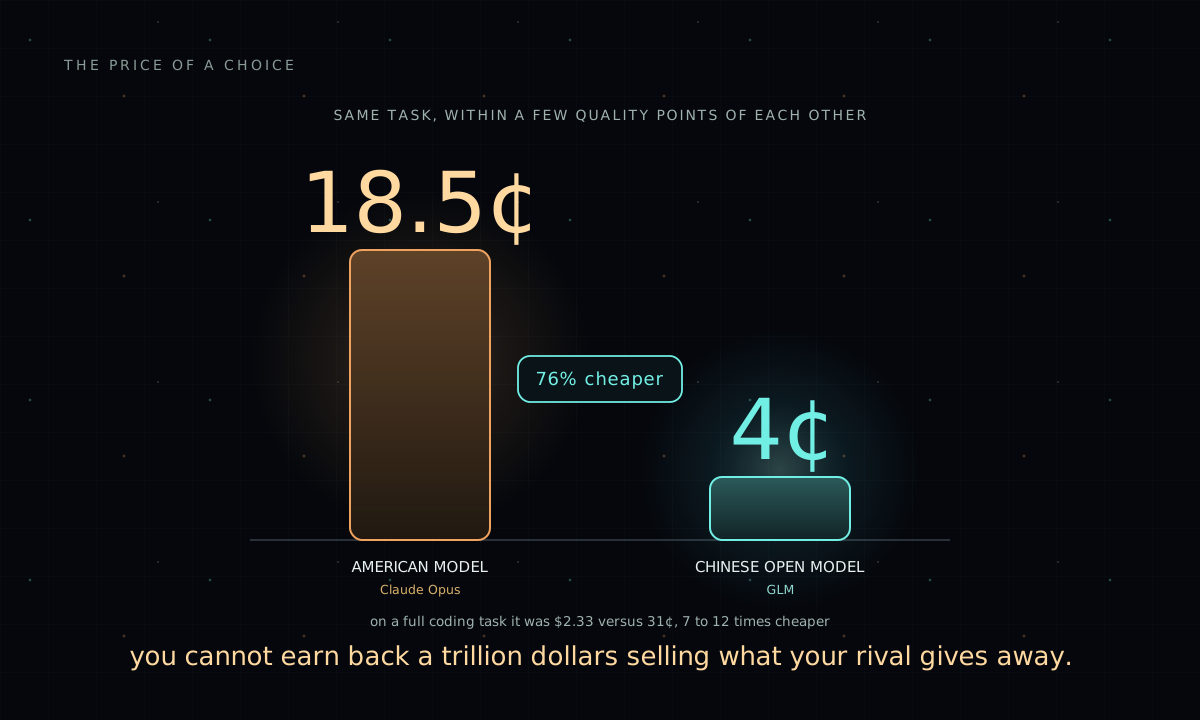
To be fair to the American side, where I spend half my week, the United States still has the single smartest model in the world. That is true.
But most businesses do not need the smartest model to answer customer service emails or process insurance claims, which is roughly ninety percent of what companies actually use AI for. For the boring majority of the work, good enough and ten times cheaper wins, and good enough is exactly what is now being given away for free.
The story holding up the market
Zoom out from any single company and the same shape reappears at the level of the whole market.
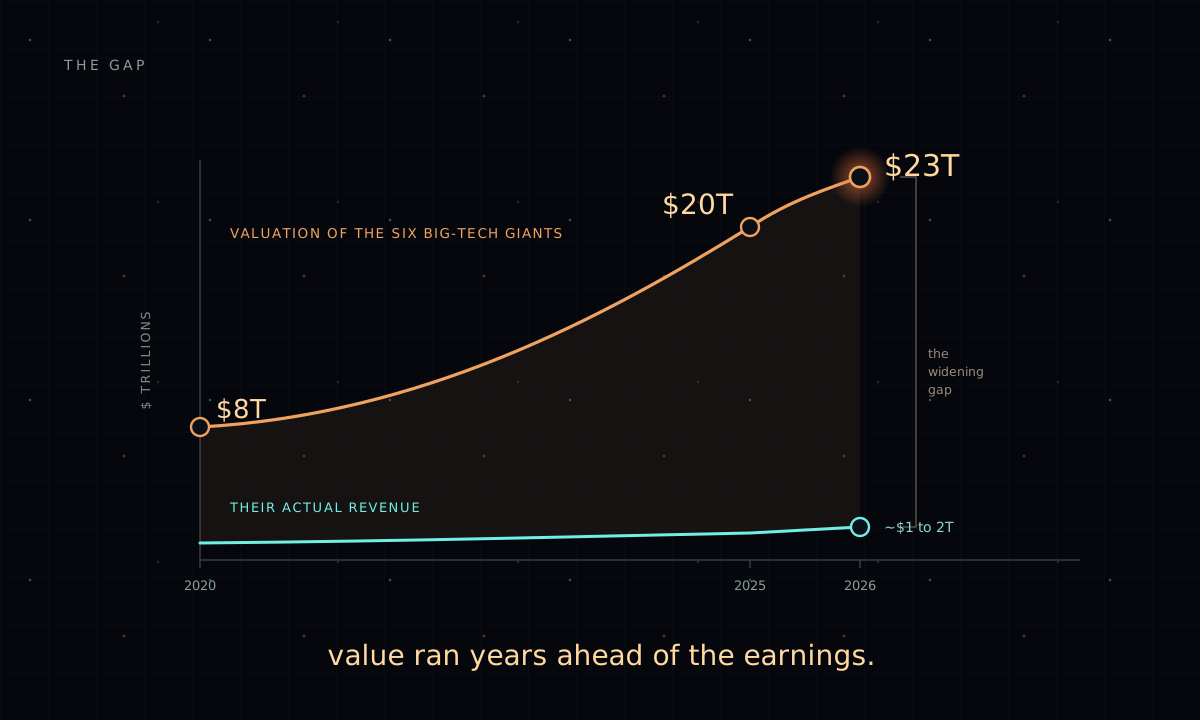
Add up the value of the largest American technology companies and the line goes almost straight up, from somewhere around eight trillion dollars five years ago to past twenty trillion now. A lot of that is deserved, because these are extraordinary businesses. But put their actual revenue on the same chart, the money customers really hand them each year, and that second line crawls along near the floor.
The distance between the two lines is the bet. It is the market saying the earnings are coming, they are just not here yet.
Sometimes that bet pays off. The internet was underhyped in the long run even though it was wildly overhyped in 1999. But the size of the gap is the size of the assumption, and this assumption is now enormous.
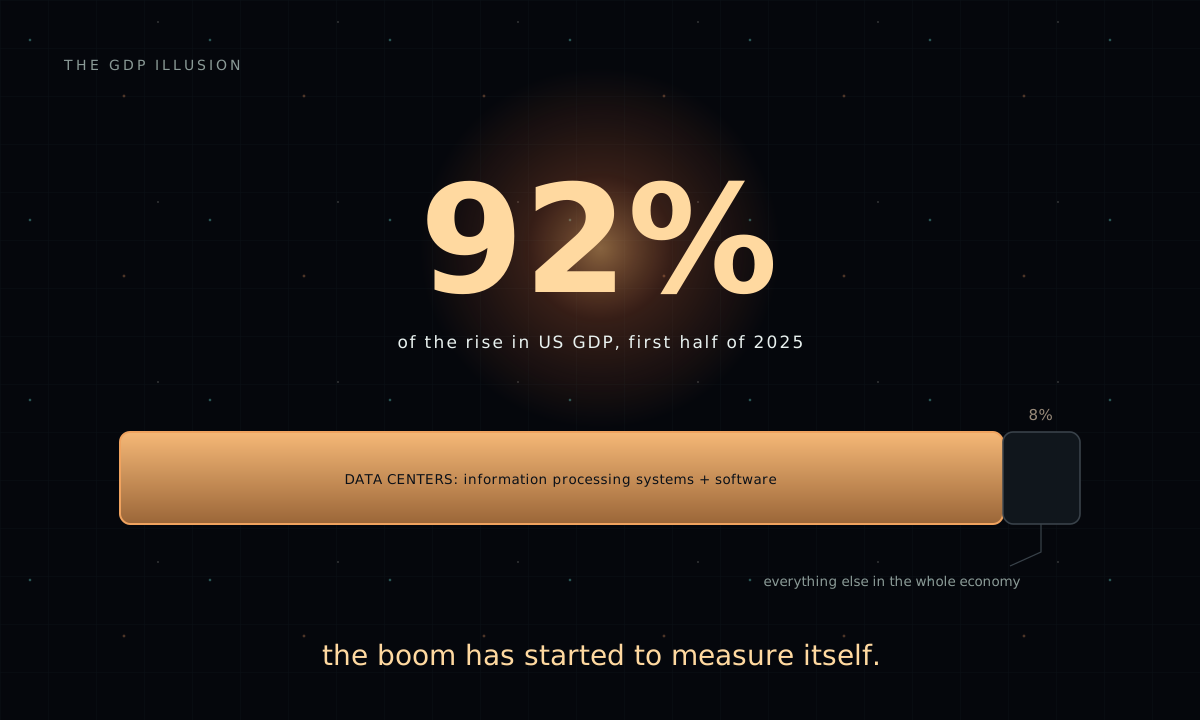
And the assumption has stopped being a market story and started holding up the actual economy. The economist Jason Furman, who chaired the Council of Economic Advisers under Obama, pulled apart the United States growth figures for the first half of last year and found that spending on data centers, the servers and the software that fill them, accounted for around ninety two percent of the growth.
Not ninety two percent of technology growth. Ninety two percent of the growth in the whole economy. Take the buildout out of the ledger and the largest economy on Earth was close to flat. So a very large share of what we are calling a boom is the boom paying to build more of itself.
So when does it pop?
Nobody knows, and everyone who has tried to time one of these has ended up in the same graveyard. But the signals worth watching are not the obvious one.
The obvious guess is that the bubble pops when the companies stop building. History says it turns earlier than that.
In the dot-com bust the NASDAQ peaked in March 2000, but the companies laying the fiber-optic cable, the data centers of their day, kept spending well into 2001. The market did not wait for the spending to stop. It turned a full year earlier, the moment enough investors stopped believing the story.
So the trigger this time is likely to be something small and boring. A big tech chief executive on an earnings call saying they are moderating the pace of their infrastructure investment. Goldman Sachs reportedly noted that the first hyperscaler to pull back on AI spending will be rewarded by the market, and this is an industry of followers. The first one to blink hands everyone else permission to blink too.
Then there is Michael Burry, the investor who called 2008. His recent charts are worth sitting with. Chip stocks are trading at the very top of their fifteen-year valuation range, priced as though the trillion dollars has already been earned.
Another of his charts splits the AI trade in two, and it is the most telling one. The companies selling the chips and the equipment are up around two hundred percent, while the hyperscalers actually spending the trillions sit barely above zero. That is the market quietly admitting it does not believe the spenders will make their money back. It is paying the people selling shovels and ignoring the people digging.
And a third chart tracks the price of AI tokens themselves, down about twenty percent from its May high, which is a strange thing for the price of a product to do during the largest buildout in its history, unless demand were sliding toward the cheaper models.
I owe you the honest caveats, because they matter. Burry has been early before, and early in markets is a polite word for wrong. Bloomberg calls the falling token price ambiguous, a signal that could mean several things.
And the calmest instrument of all, the bond market, is not worried in the slightest. Credit spreads, the extra interest lenders demand to hold risky corporate debt, sit near two and a half percent, about as tranquil as they have ever been.
Which leaves two possibilities. Either the lenders see no problem and this whole essay is wrong, or the lenders are wrong, the way they were in early 2007, when spreads were just this calm and Bear Stearns was months from blowing up. Spreads do not measure what is true. They measure what lenders believe.
We have stood here before
None of this is new. That is the strangely comforting part.
In the winter of 1637 a single rare tulip bulb in the Netherlands could be swapped for a canal house. Not a picture of a house. The house.
Bulbs traded through a web of promissory notes, buyers who never meant to take delivery selling to buyers who never meant to take delivery, the price set entirely by the next person's willingness to believe. Then one ordinary morning at a routine auction in Haarlem, nobody bid. That was all it took. The notes were worth what the flowers were worth, and the flowers, it turned out, were worth being flowers.
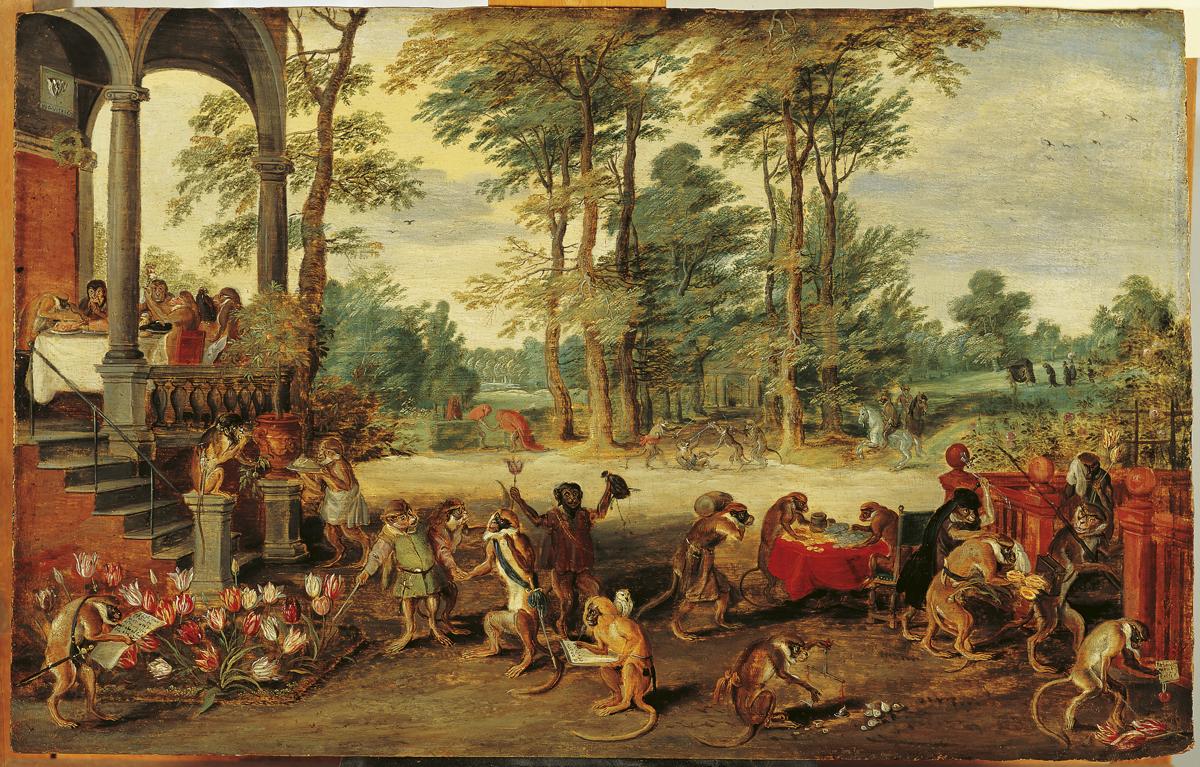
A Flemish painter later mocked the whole affair by painting the speculators as monkeys in merchant clothes, weighing bulbs and settling accounts and being hauled off to court. That painting is on the cover of this piece, and the joke has aged extremely well.
Eighty years later England ran the same experiment with a company. The South Sea Company was handed a monopoly to trade with South America, promised investors the earth, and watched its shares rise about eightfold in a single year on almost no actual trade. Members of Parliament were in on it.
When it broke, it broke a lot of ordinary people who had climbed in near the top, and William Hogarth engraved the aftermath as a demonic carousel with Honesty being broken on a wheel in the corner. Isaac Newton, one of the smartest humans who ever lived, lost a fortune in it and reportedly said he could calculate the motions of the heavenly bodies but not the madness of people.
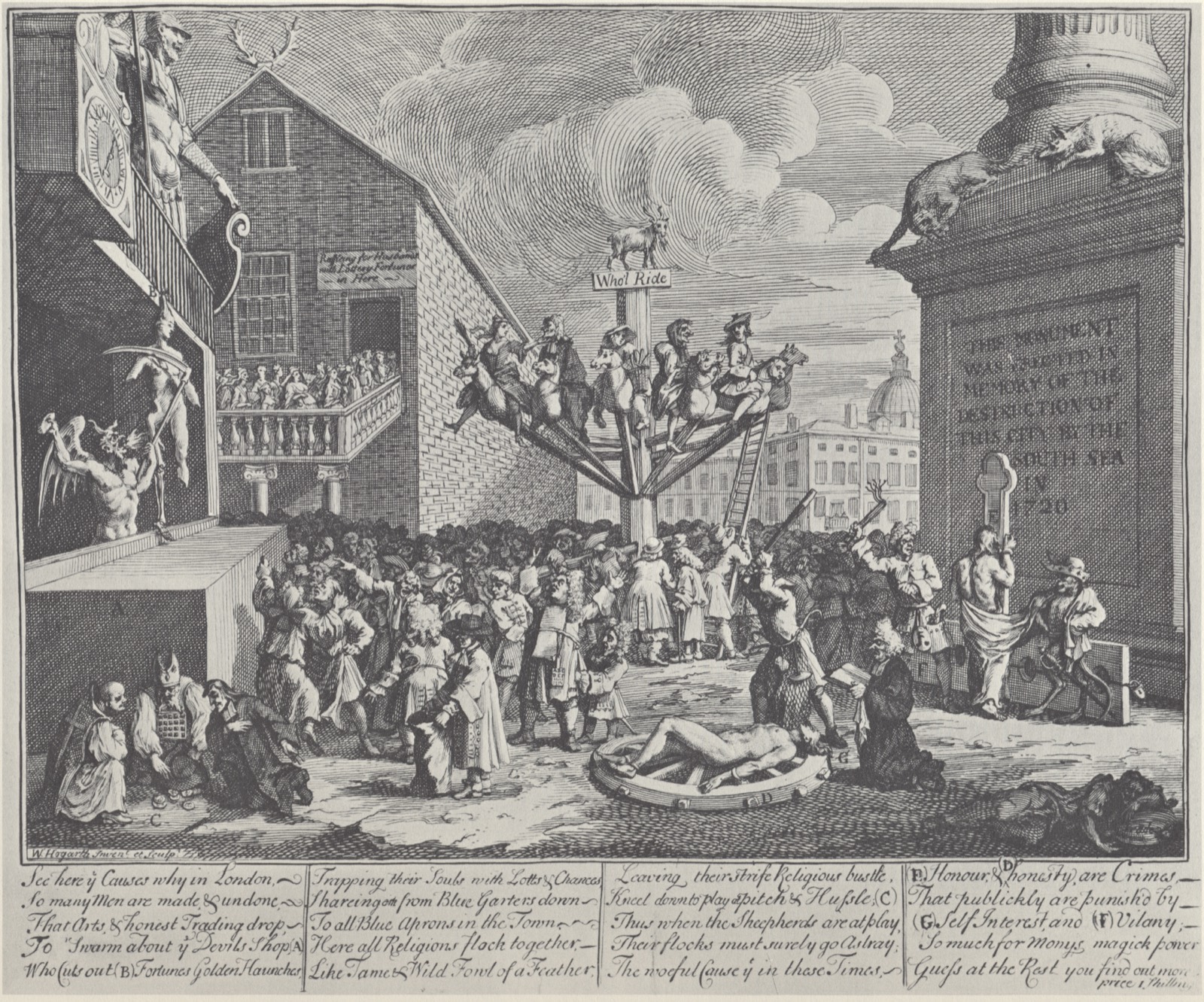
The pattern under all of them is the ouroboros, not the tulip and not the ship. A price justified only by the next person's belief in the price. Money that circulates fast enough to look like production. A story good enough that clever people talk themselves past the arithmetic.
Tulips, South Sea shares, railway stock in the 1840s, radio in the 1920s, dotcom domains in 1999. The costume changes every time. The animal underneath is always the same.
Newton could compute the heavens and not the madness of men. We have better telescopes now and exactly the same blind spot.
The bubble and the railroad are the same event
And here is the turn, the thing that stopped me from simply nodding along to the doom.
Go back to that railway mania in the 1840s. British investors poured money into hundreds of railway companies, most of the schemes were nonsense, and the crash wiped out a generation of savings. A genuine catastrophe for the people who lived through it.
But when the smoke cleared, the rails were still in the ground. The money was gone and the network remained, and Britain ran its trains on those tracks for the next century.
The dot-com bust did the same thing in a different key. It torched a trillion dollars of paper wealth and a lot of foolish companies, and it left behind the fiber-optic cable, the data centers, and the trained engineers that the next decade of the real internet was built on top of. Amazon nearly died in that crash. Amazon is also a child of it.
This is the part that took me a while to hold in my head without flinching. The bubble and the infrastructure are not two competing stories about what is happening. They are the same event seen from two distances.
Up close, in the money, it is a mania, and a lot of capital is going to be destroyed, and some of it will be yours or your uncle's or a pension you have never heard of.
Step back a few decades and it is a buildout, and the chips and the power stations and the tooling and the people who learned to make this stuff work do not evaporate when the valuations do. They get bought for cents on the dollar by whoever is still standing, and the actual future runs on them.
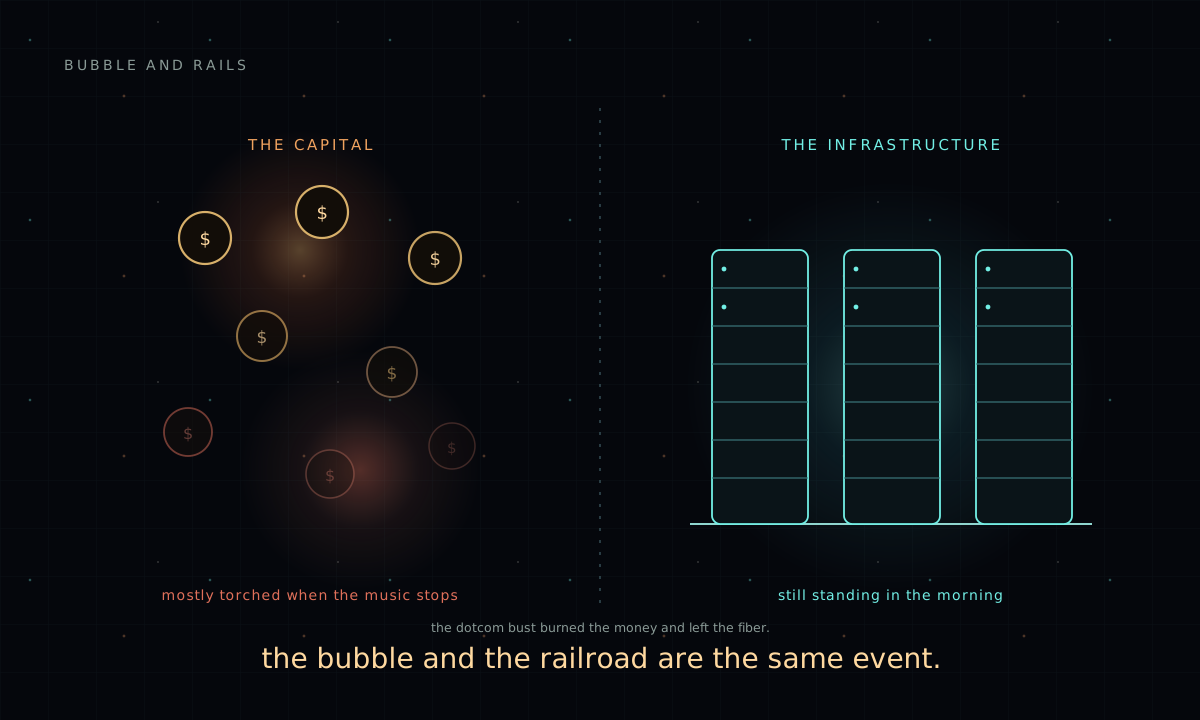
So both things are true and you have to carry both. Yes, the financing looks circular, the product loses money on every sale, and a rival is giving away ninety percent of the quality for free. Yes, some of this will end in tears and take real savings with it.
And also yes, when this particular music stops, the world will still have the largest buildout of computing power in its history sitting there, mostly paid for, ready for whoever figures out how to make it return more than it costs.
The mania funds the infrastructure. It always has. That is the ugly, efficient way our species pays for the future, by fooling enough people into overbuilding it.
What I actually do with this
I am not going to pretend I can time it, because the whole history above is a graveyard of people smarter than me who tried.
What the shape changes is not my conviction about the technology, which is intact, but my relationship to the numbers around it.
When I see a partnership announced, I now ask which direction the money is really flowing and how many times it gets counted before it settles. When I see a valuation, I look for the revenue line underneath it and measure the gap. When someone prices intelligence by the token instead of by the result, I ask what they are afraid to promise.
And when I build, I try to own the part that matters, the model and the data and the weights, rather than rent it from someone who can watch over my shoulder and change the terms. Not out of paranoia. Out of the same instinct the enterprises in that video are acting on, which is that a capability you do not control is a capability someone can take back.
The tulip was a real flower. It is still a beautiful flower. People just briefly agreed it was worth a house, and then, on an ordinary morning, stopped agreeing.
The AI is real too, more real than tulips ever were, and it will matter long after this cycle is a chapter in a book with a Hogarth engraving on the page. The trick is to believe in the flower without believing in the house.
Believe in the technology. Count the money like it is trying to fool you. Both at once, or you will get exactly what the ring is built to hand you.
When the crash comes, and something will crack, because something always does, the question that separates the people who get hurt from the people who keep building is not did you see it coming. Almost nobody times it.
The question is whether, when the music stopped, you were holding the flower or the house.