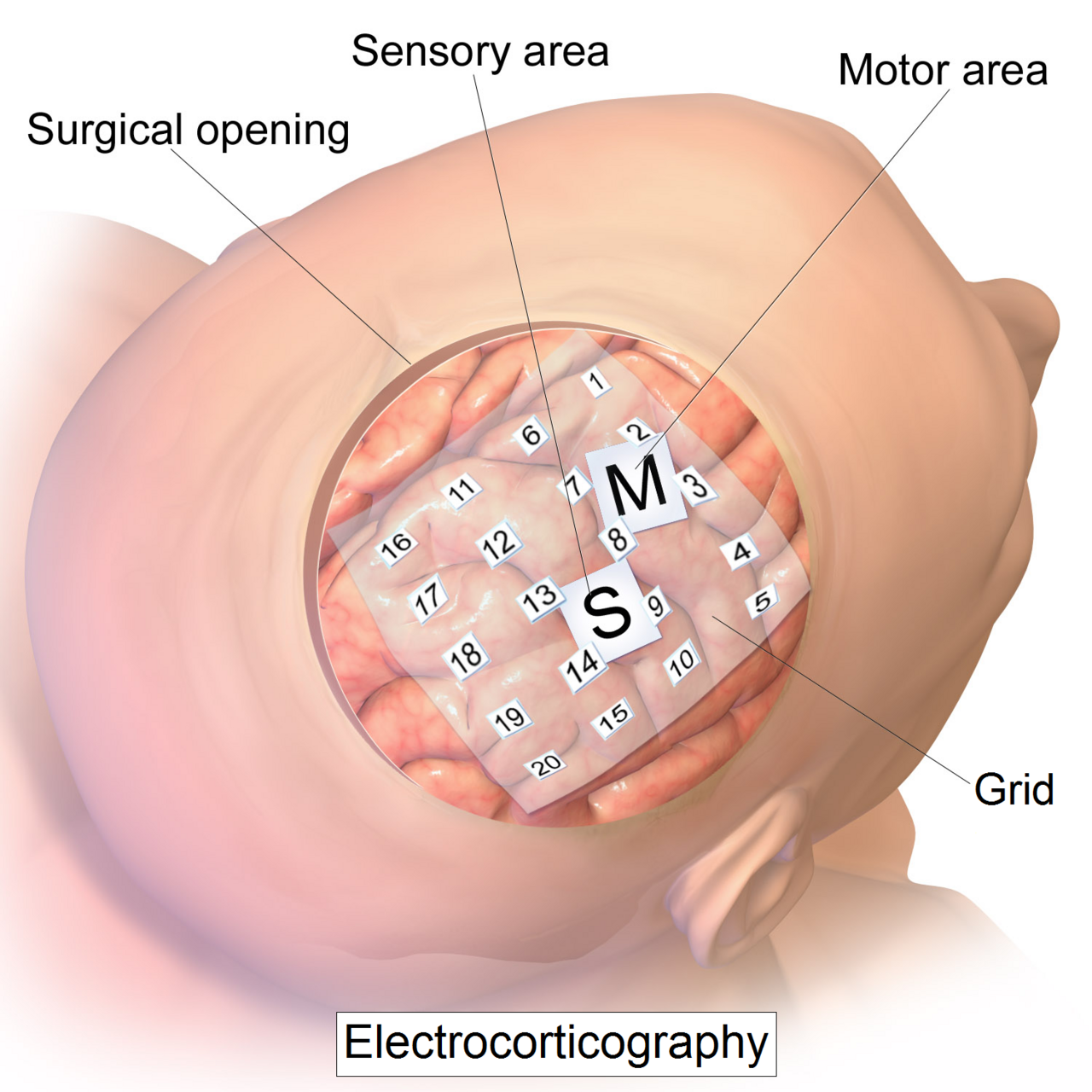
There's a woman at UC San Francisco who hasn't spoken out loud in years. A stroke took the muscles, not the mind. In 2023 she sat in front of a screen with a digital version of her own face on it, tried to say a sentence, and the avatar said it for her. Out loud. In a voice they'd rebuilt from old recordings, while the words scrolled as text underneath. None of it came through her mouth. It came off a sheet of electrodes lying on the surface of her brain, decoded on the fly, at roughly seventy-eight words a minute.
I read that paper twice and then just sat with it for a while.
It's real. It ran in Nature. And it's only one of four things that happened to our understanding of the brain in the last five years, any one of which I'd have expected to dominate the news for a week. None of them really did. They got a science-section headline and then we all went back to arguing about chatbots.
I have a job-shaped reason to care about this. I build a company whose whole bet is that a conversation is data, that the stuff passing between people can be captured and structured into a memory you can actually query later. So when scientists start pulling structured meaning straight out of cortex, I pay attention. But honestly that's not why I stay up reading this stuff. I stay up because the brain is the one object in the universe you live inside and can't open. For all of history it was a sealed room. You could reason about it, meditate on it, break it and watch what stopped working. You couldn't read it.
That's the part that changed. Not the philosophy. The plumbing of what's knowable.
Cognitive neuroscience, right now
The study of how lumps of electrified tissue produce a mind: seeing, remembering, talking, being someone. The questions are ancient. What's new is the gear. Language models that read meaning off cortex. Electron microscopes that trace every wire in a speck of brain. Light switches wired into single memories. And, for the first time, referee matches that force rival theories to bet in public and lose. The field quietly stopped being a philosophy seminar and turned into engineering.
And once I'd read enough of these papers back to back, the same shape kept showing up under all of them. I'll just say it plainly, because it's the spine of everything below.
We can now do far more to the brain than we can explain about it.
We decode speech we can't define. We map circuits we can't read. We switch memories on and off without knowing how they mean anything. And when we finally made our two best theories of consciousness compete, both of them lost. The tools are years ahead of the ideas. That gap, not any single result, is where the field actually is.
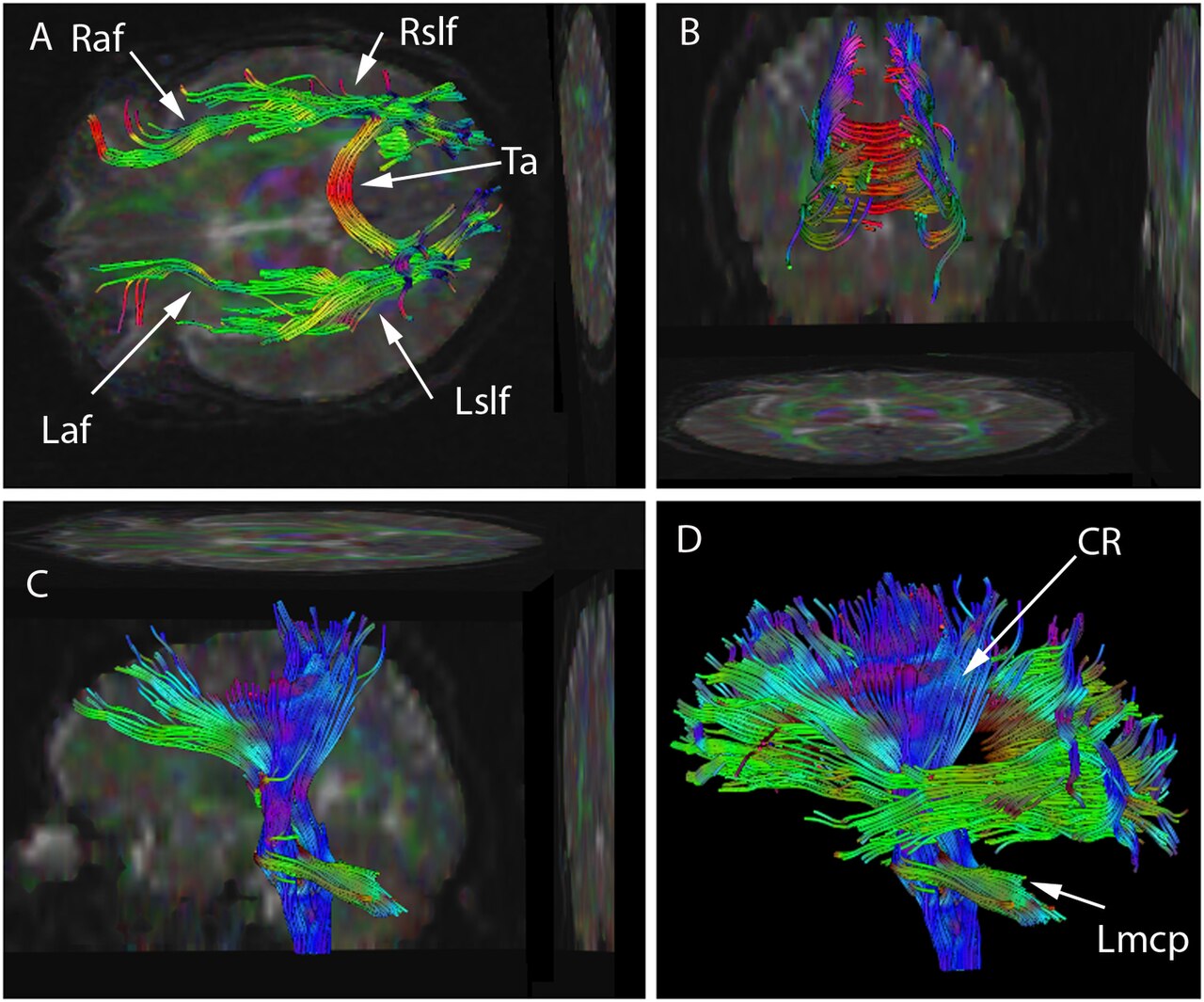

First, the brain started talking
Start with the one that reads like science fiction, because it basically is.
In 2023 two different teams gave speech back to people who'd lost it. At Stanford they pushed electrode arrays into the speech cortex of a man with ALS, a man nobody could understand anymore, and turned his attempts to talk into text at sixty-two words a minute. The old record was about a third of that. Normal conversation is around a hundred and sixty, so he was getting close to half of natural speed, by intention alone. The UCSF team is the woman from the top of this piece. Same year, different lab, and they pushed it further: text, a synthesized voice, and an animated face, all coming off one stream of brain signal at once.
Two systems decoded attempted speech in people who couldn't talk, at 62 and 78 words per minute over large vocabularies. The first real large-vocabulary speech decoding from neural signal. The UCSF version drove text, voice, and a facial avatar together, in real time.
Willett, Kunz et al., Nature 620 (2023), 10.1038/s41586-023-06377-x. Metzger, Chang et al., Nature 620 (2023), 10.1038/s41586-023-06443-4
The speed isn't even the part that gets me. It's the currency they trade in. These systems don't look up whole words in a table. They read the small stuff, the attempted phonemes, the shapes the mouth was reaching for, and then a language model guesses the sentence. The same flavour of model you were arguing with this morning. Brain on one side, model on the other, meeting in a shared statistical space that, twenty years ago, nobody would have guessed they had in common.
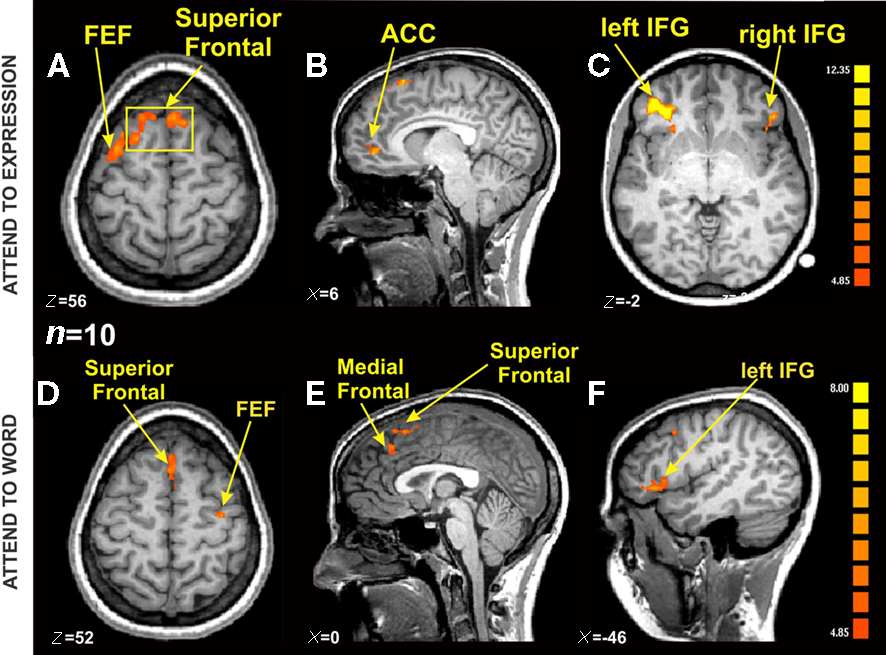
Then, the same year, came the one that should be more famous than it is. A group at UT Austin built a decoder that needs no surgery at all. You lie in an fMRI scanner, you listen to a story or just imagine telling one or watch a silent film, and the thing reconstructs the gist. Not your exact words. What you meant.
A decoder reconstructed the gist of perceived speech, imagined speech, even silent video, from ordinary non-invasive fMRI. About half the time it landed close to the intended meaning. "I don't have my driver's license yet" came back as "she has not even started to learn to drive yet." Wrong words. Right idea.
Tang, LeBel, Jain, Huth, Nature Neuroscience 26 (2023), 10.1038/s41593-023-01304-9
Look at that example again, because it's doing something quietly enormous. The decoder didn't get the sentence. It got the idea and put it in completely different words. Which means fMRI isn't watching language up there. It's watching the layer under language, where a thought still hasn't picked which sentence to become.

The convergence goes deeper than one clever pipeline, though, and this is the bit that genuinely unsettles me as a builder. In 2025 a team across Princeton, Hebrew University and Google recorded a hundred hours of real, messy, everyday conversation from electrodes in four people, then modelled all of it with a single embedding space running from sound to speech to meaning. The kind of space that lives inside a large language model. And the brain's own activity tracked that space, region by region, as words went in and came out. The model wasn't just a handy tool for prediction. Its internal geometry lined up with the cortex.
Across ~100 hours of natural conversation, one acoustic-to-speech-to-language embedding space (the sort inside an LLM) tracked the neural activity of everyday talking and listening. Evidence that brains and language models land on overlapping ways of representing meaning.
Goldstein, Hasson et al., Nature Human Behaviour 9 (2025), 10.1038/s41562-025-02105-9
We spent years insisting these machines are nothing like us. Then we trained one to guess the next word, and it grew a map that rhymes with the one in your head. I don't think that means an LLM is a brain. It probably means there are only so many good ways to compress language, and both biology and gradient descent keep stumbling onto the same ones. But "keeps stumbling onto the same ones" is a sentence I find hard to put down at night.

For the first time the brain has a way out that doesn't go through the body. The thought no longer needs the mouth.
Two reactions hit me at once here. The builder gets greedy: this is a decade of raw material. The other part, the part that reads Vedanta on Sunday mornings, goes quiet. We learned to read the expression of a mind off the meat. We did not touch the thing doing the expressing. Hold onto that, because we're going to need it in a few sections.
Then it showed us where a memory actually sits
You remember your last birthday. Where is that, physically? Which part of you is holding it right now?
For most of the last century that question had no real answer. A memory was a pattern, a ghost smeared across the wiring, nowhere you could point to. In the last few years it got an address. The address has a name. It's called an engram, and it's the specific, small set of neurons that physically changed when you learned the thing, and that hold it now.
That stopped being a metaphor, and that's the news. You can tag the exact cells that light up while a mouse learns to fear a room. Then, days later, in a totally different and perfectly safe room, you flick those cells back on with a pulse of light, and the mouse freezes. It's scared of nothing. It's remembering a danger that isn't there, because you reached in and pressed the memory yourself.
Flip the tagged cells from a learning episode back on with light, and the animal recalls the memory with no cue from the world. The cells that get the job are the ones that happened to be most excitable at the time (high CREB, which also grows their connections), and they hold the trace as stronger synapses.
Josselyn & Tonegawa, Science 367 (2020), 10.1126/science.aaw4325. Guskjolen & Cembrowski, Molecular Psychiatry 28 (2023), 10.1038/s41380-023-02137-5
Sit with the word "switch on." Not "these cells correlate with the memory." Stimulate them alone, in an empty room, and the whole experience comes back. The trace is a real, findable, editable thing in there.
And which neurons get picked isn't random. It's whichever ones were already a little more excitable in that moment, already leaning forward, primed by a protein called CREB. Making a memory is a competition, and the prize goes to whoever was halfway out of their seat.
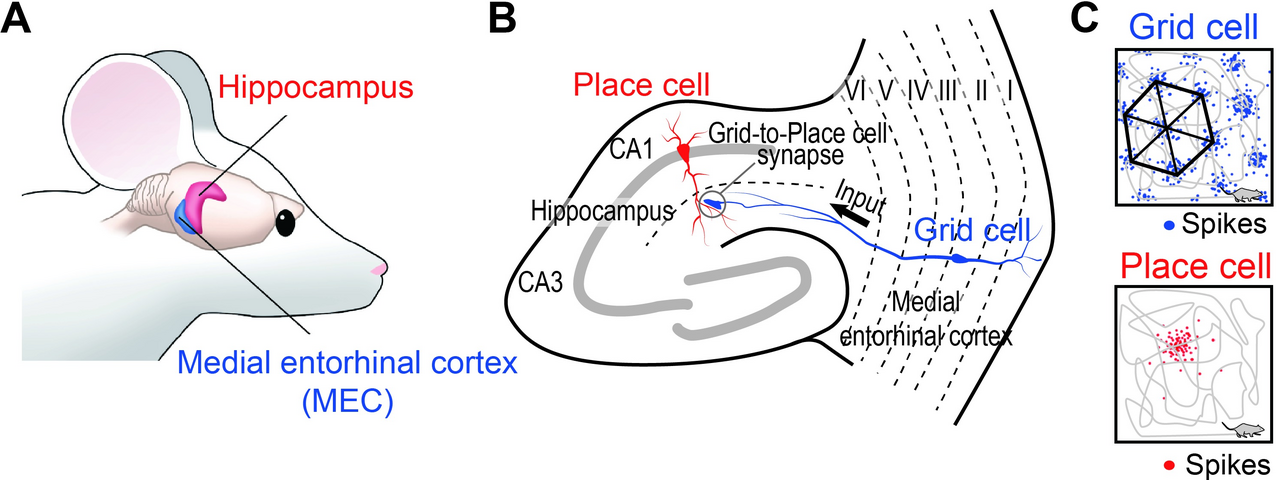

Then there's sleep, which everyone underrates. We've known for ages that sleep locks memories in. What got sharper recently is how absurdly precise the mechanism is. A Michigan group showed in 2024 that keeping mice awake right after learning breaks the replay of engram cells in one specific sub-strip of one tiny structure, the inferior blade of the dentate gyrus, while leaving its neighbour a fraction of a millimetre away basically fine.
Lose sleep right after learning and you selectively wreck the reactivation of engram neurons in the inferior blade of the dentate gyrus. Which pins that little structure as central to sleep-dependent consolidation, and shows sleep loss hits the hippocampus with surgical, sub-region precision.
Wang, Park, Aton et al., iScience 27 (2024), 10.1016/j.isci.2024.109408
I want to be straight about the edge of this, because science writing loves to round everything up to certainty. The seductive version of the story goes: the hippocampus replays your day in fast-forward while you sleep, and that replay is what burns the memory in. As correlation, that's on solid ground. As cause, it's genuinely still up for grabs. When people tried to nail the strongest causal form of the claim, it didn't cleanly hold. So: the mechanism is real, the full chain of "this replay causes that memory" is not yet locked. Both of those are true at the same time, and pretending otherwise would be lying to you.
It isn't a file you open. It's a fire you relight from a handful of embers every single time, and call it the same flame. That's exactly why memory is editable, suggestible, and wrong more often than any of us want to admit.
Here's where it hits my actual work. The faithful, replayable memory people think they have? Biology didn't build that. Biology built a lossy, reconstructive index that quietly rewrites itself every time you read it. I spend my days trying to turn conversations into memory you can inspect and trust, and the hardest thing to explain to people is that they aren't competing with some perfect internal recording. There's no such recording. The honest pitch isn't "better than your memory." It's "a second copy that doesn't edit itself overnight while you sleep."
Then we put consciousness on trial
Now the hard one. Not how the brain computes, but why there's somebody home while it does it. Why it feels like something to be you. The hard problem. For decades that question lived in seminar rooms and most working scientists kept a careful distance, because it looked untestable by design.
In the last five years they dragged it into the lab anyway. And the result is the most honest thing in this whole essay, and the most humbling, which is funny because I just told myself to stop using that word.
Two big theories have run the show. Integrated Information Theory says consciousness is integrated information, that experience lives wherever the system forms a single, tightly knit whole, and it puts that in a hot zone at the back of the brain. Global Neuronal Workspace Theory says consciousness is broadcast, that a piece of information goes conscious when it gets "ignited" and flung across the whole cortex, especially the front, so everything else can use it. Back of the brain versus front. A standing whole versus a broadcast. Two real, different bets about where you are.
So they did something science almost never does. The two camps signed a deal, in advance, in writing, naming exactly what each theory predicted and what result would count as a loss. No moving the goalposts afterward. Neutral labs ran it. They scanned 256 people across fMRI, MEG, and electrodes sitting inside the brains of epilepsy patients, and published it in Nature in 2025.
Nobody won.
A preregistered head-to-head of IIT and GNWT (256 people) confirmed some predictions of each and broke core ones in both. The prefrontal "ignition" GNWT banked on didn't show up: none of 655 prefrontal electrodes did what the theory said they would, and conscious content was barely represented up front. The sustained posterior synchrony IIT banked on wasn't there either. Both need serious repair.
Cogitate Consortium, Nature 642 (2025), 10.1038/s41586-025-08888-1
Look at what fell over. GNWT bet on a burst of prefrontal activity when a stimulus comes and goes. Across six hundred and fifty-five electrodes sitting in the fronts of conscious human brains, that burst didn't appear. IIT bet that the back of the brain holds a sustained, synchronized web while you experience something. The web was brief, not sustained, and missing in the frequency band the theory leaned on hardest. Each theory got its signature prediction tested at point-blank range, and each one missed.
People read this as a crisis for the field. I read it as the opposite. Two serious theories put real money on the table, the universe looked at both and said no, and for once nobody got to quietly wriggle out of it afterward. That almost never happens, and it's worth more than a clean win would have been.

Then it got nastier. While the experiment was running, a separate fight broke out over whether one of these theories even counts as science. In 2023 more than a hundred researchers signed an open letter calling IIT "pseudoscience." In 2025 a sharpened, peer-reviewed version landed in Nature Neuroscience, signed by a list that includes Yoshua Bengio and the late Daniel Dennett, arguing that IIT's core claims can't be tested even in principle. A theory that implies the whole cosmos is faintly sentient, or that a grid of inert logic gates could be conscious, has, in their view, wandered off the map while still wearing the lab coat.
"What makes a theory of consciousness unscientific?" The 100-plus "IIT-Concerned" group argued in Nature Neuroscience that IIT dresses up untestable claims as empirical science. IIT's own people reject the framing entirely. It's unresolved, and it's partly a philosophy fight, not only an experiment.
Schurger et al. (IIT-Concerned), Nature Neuroscience 28 (2025), 10.1038/s41593-025-01881-x. Background: Nature news, 2023
I can't fully take a side, and I think that's the honest place to stand. The critics are right that a theory with no possible disconfirming observation isn't doing empirical work. But the thing they're circling, that your inner experience refuses to collapse into a third-person measurement, isn't something they've solved either. That's just the original mystery, still sitting in the room, still staring at everybody.
This is the exact spot where the new science presses up against something the old texts have said for a very long time. Those instruments can map every neural correlate of an experience and still not lay a finger on the experiencing. The eye doesn't see itself. The Vedanta I read calls the deepest layer of you the witness, the thing that is aware of every state and is never itself one more object you can be aware of. You can call that mysticism. After this experiment you can also read it as a weirdly precise account of why measurement keeps walking right up to consciousness and finding no handle on the inside. We have gotten very, very good at the correlates. We have not laid a finger on the thing they are correlates of.
We measured the brain harder than ever and proved, cleanly, that we don't yet have a theory of the one thing it's most famous for.
And quietly, we started drawing the full wiring diagram
While all that was happening, a slower and, in some ways, more ambitious project crossed its first finish lines. Not reading the brain, not theorizing about it. Tracing it. Every neuron, every synapse, the whole circuit.
In October 2024 a worldwide effort run out of Princeton released the first complete wiring diagram of an entire adult brain. A fruit fly's. Not a slice of it. All of it.
FlyWire mapped the complete adult fruit-fly brain: 139,255 neurons and around 50 million synapses, reconstructed from electron microscopy, shipped as a stack of nine papers, with cell types and best-guess neurotransmitters attached.
Dorkenwald, Seung, Murthy et al. (FlyWire), Nature 634 (2024), 10.1038/s41586-024-07558-y
A hundred and thirty-nine thousand neurons sounds like a lot until you remember you're carrying about eighty-six billion. The fly's whole brain is roughly six hundred-thousandths of one of yours. And mapping it took a global team, several years, and a small army of AI segmentation models with humans checking their work.
So you ask the obvious next question, the human one, and the numbers go a bit vertical. Also in 2024, the Lichtman lab at Harvard and Google put out H01: a full reconstruction of a single cubic millimetre of human cortex.
H01 reconstructed about 1 mm³ of human cortex down to the synapse: roughly 57,000 cells, 150 million synapses, 230 mm of blood vessels, all of it captured in about 1.4 petabytes of imaging. One cubic millimetre. You've got on the order of a million of them.
Shapson-Coe, Januszewski, Lichtman et al., Science 384 (2024), 10.1126/science.adk4858
Do the arithmetic the paper is too polite to spell out. One cubic millimetre runs to 1.4 petabytes. A whole human brain is on the order of a million cubic millimetres. So the raw map of one person's brain, at this resolution, is something like an exabyte before anyone has understood a single thought inside it.
That's the data just to store the wiring of one head, never mind run it or read it. We can now see the brain in total detail and be more lost than before, because total detail is not the same thing as understanding. A perfect map you can't read yet is a strange, real kind of progress.
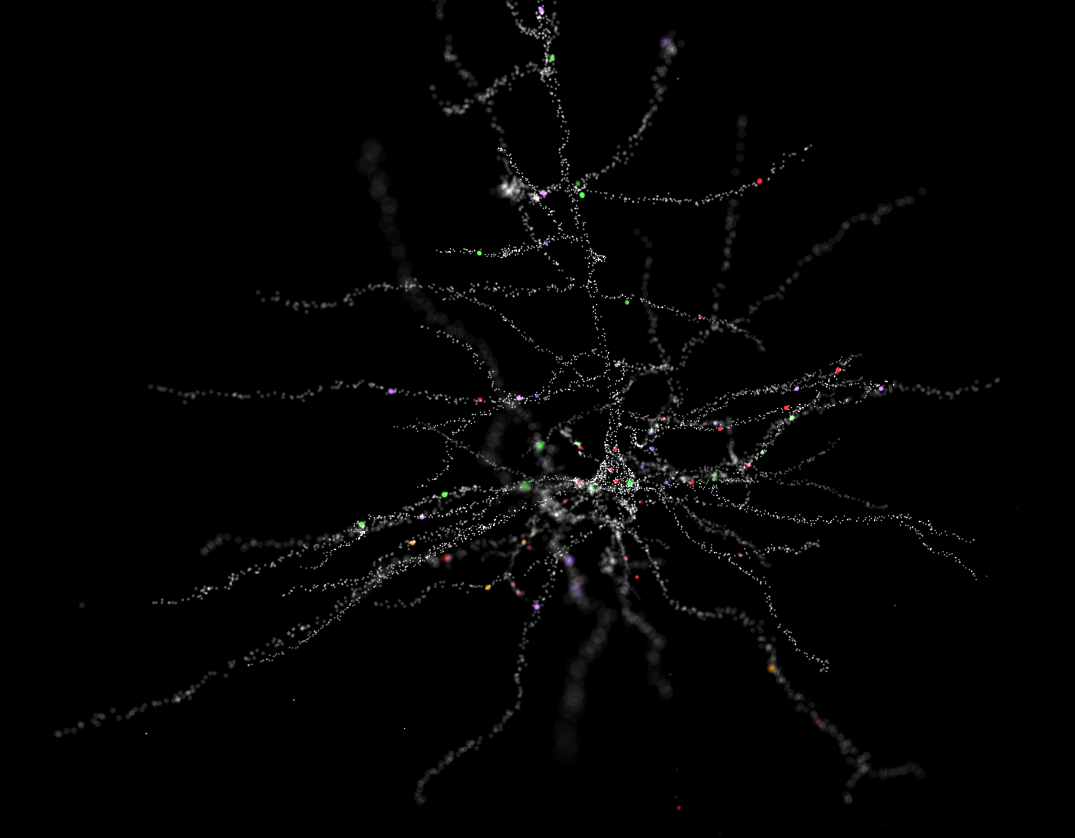

Then in 2025 the middle rung of the ladder arrived and did something the other two didn't. The MICrONS team mapped a cubic millimetre of mouse visual cortex, but first they filmed the living tissue at work, watched the same neurons fire as the mouse looked at things, and only then sliced and reconstructed it. Function and structure, in the same piece of brain.
MICrONS paired live two-photon recordings with a full electron-microscope reconstruction of the same ~1 mm³ of mouse visual cortex: about 120,000 neurons, more than 523 million synapses, roughly 4 km of axon. First time a chunk of mammalian cortex was captured as both a living, firing system and a complete wiring diagram.
The MICrONS Consortium, Nature 640 (2025), 10.1038/s41586-025-08790-w
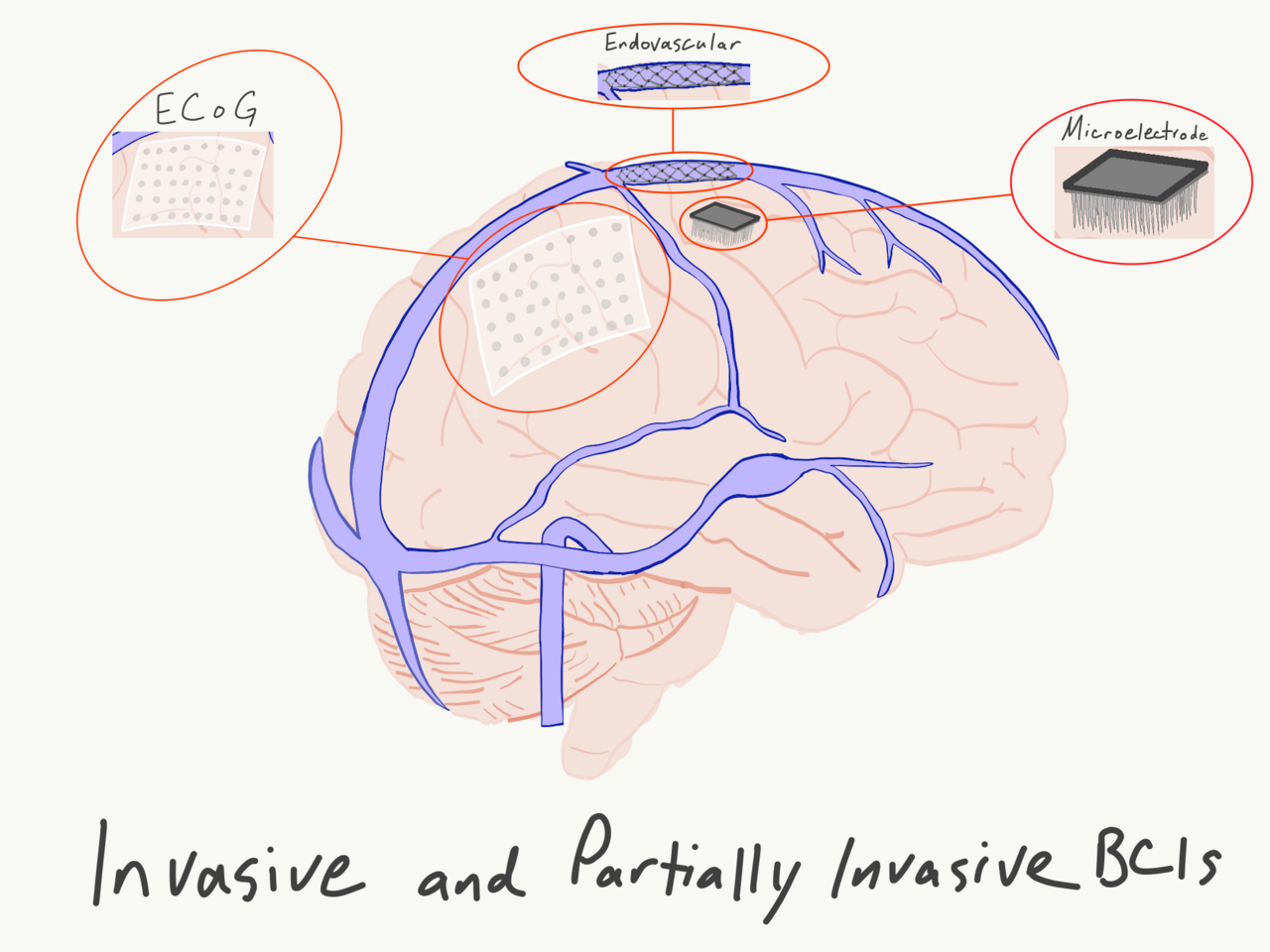
The same five years pushed the other way too. Not just reading the brain but plugging into it, and even growing it. In early 2024 Neuralink put its first implant into a human, a man paralyzed since a diving accident, with a chip carrying 1,024 electrodes on 64 threads thinner than a hair. He learned to move a cursor, play chess, play Civilization, by intention. It also taught everyone a real lesson about the gap between a demo and a product: a lot of those threads pulled out of the tissue in the weeks after surgery, performance dropped, and the team had to claw it back in software. By 2026 a handful more people are carrying implants, and a rival, Synchron, is pushing a version that slides in through a blood vessel and skips opening the skull at all.
Researchers are also growing neural tissue and connecting living cells to electronics. These experiments need to be distinguished. The 2022 DishBrain study used cultured mouse or human neurons coupled to a simulated Pong environment, and reported learning-related changes within about five minutes under its feedback conditions. Three-dimensional brain organoids are another line of research. Neither setup is a complete brain. Kagan et al., Neuron.
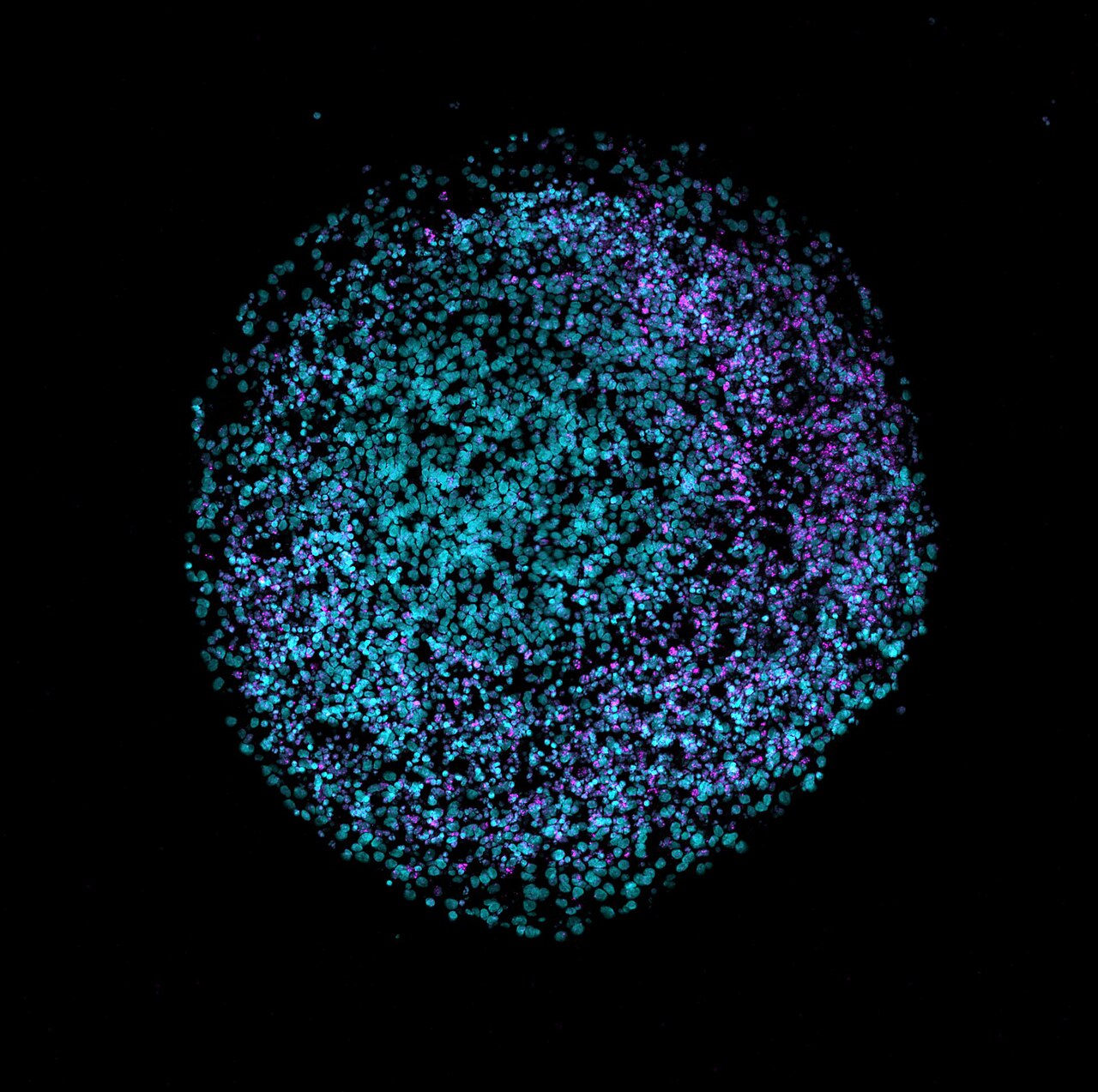

The interesting result is that a culture changed its activity and task performance in response to a carefully designed feedback loop. The word “learned” is useful here if we keep the measured behaviour attached to it. It does not settle the question of subjective experience.
The thing under all four
Step back far enough and the four stories rhyme.
We decode meaning we can't define. We map circuits we can't read. We flip memories on and off without knowing how they mean anything. And when we finally made our theories of consciousness make honest bets, both of them lost. Every frontier is the same story told from a different angle. The gear got way out ahead of the ideas.
I don't say that as a complaint. It's what real progress looks like from the inside. The telescope always shows up before the cosmology. We're in the telescope era of the brain right now, drowning in resolution and starving for the theory that would make any of it mean something.
As a builder, this is the best possible news, because the gaps are where the work is. Every one of these is a thing we couldn't do five years ago, and capabilities compound. The brain has output channels that skip the body now. Memory has a physical address. Mapping it is becoming routine. There are a dozen new ways to wire into it. That's a decade of raw material for anyone building at the line between mind and machine, and I intend to use it.
As the guy who reads the old books, it lands somewhere else. The harder we push the instruments, the cleaner the outline they draw around the one thing they can't reach. The witness keeps backing away by exactly the distance we advance. We are mapping the palace down to the last brick and never once meeting whoever lives there.
Both of those are true. I've made my peace with holding them at the same time, most days.
For all of history the brain answered every question the same way, with silence. In the last five years it finally started answering. In text, in voltage, in wiring diagrams a million times too big to read, in one clean verdict that our best theories of mind aren't ready.
It started talking back. We're still figuring out the language. And the one actually doing the talking, the real one, still hasn't shown its face.
We learned to read the brain before we learned to understand it. The space between those two is the whole frontier, and maybe the place the mind was hiding all along.
Notes & Sources
Every number in here traces back to a peer-reviewed paper or an official source. The landmark studies, grouped by section:
- Brain meets AI · decoding Willett et al., "A high-performance speech neuroprosthesis," Nature 620 (2023), 62 wpm intracortical decoding. Metzger, Chang et al., "A high-performance neuroprosthesis for speech decoding and avatar control," Nature 620 (2023), 78 wpm, text, voice, avatar. Tang, Huth et al., "Semantic reconstruction of continuous language from non-invasive brain recordings," Nature Neuroscience 26 (2023), fMRI semantic decoding. Goldstein, Hasson et al., Nature Human Behaviour 9 (2025), a shared brain-and-model embedding space.
- Memory · engrams Josselyn & Tonegawa, "Memory engrams: recalling the past and imagining the future," Science 367 (2020), allocation, sufficiency, the synaptic story. Guskjolen & Cembrowski, Molecular Psychiatry 28 (2023), encoding, consolidation, retrieval. Wang, Aton et al., iScience 27 (2024), sub-region-specific sleep consolidation.
- Consciousness Cogitate Consortium, "Adversarial testing of global neuronal workspace and integrated information theories of consciousness," Nature 642 (2025), the referee match. IIT-Concerned collective, "What makes a theory of consciousness unscientific?," Nature Neuroscience 28 (2025), the pseudoscience argument, with 2023 background.
- Connectomes and interfaces Dorkenwald, Seung, Murthy et al., "Neuronal wiring diagram of an adult brain," Nature 634 (2024), FlyWire. Shapson-Coe, Lichtman et al., "A petavoxel fragment of human cerebral cortex," Science 384 (2024), H01. The MICrONS Consortium, Nature 640 (2025), mouse cortex, wiring plus function. Neuralink, first human, "A Year of Telepathy". Kagan, Kitchen et al., "In vitro neurons learn... when embodied in a simulated game-world," Neuron 110 (2022), DishBrain. Hartung et al., "Organoid intelligence," Frontiers in Science (2023), the OI roadmap.
Research for this piece went through a multi-source, adversarial fact-check; the photos are openly-licensed images that illustrate the methods, not reproductions of the papers' own (copyrighted) figures, and the two captioned images are my own jokes laid over them. Image credits, in order: white-matter tractography (Gigandet et al., CC BY-SA 3.0); ECoG grid (CC BY 3.0); the fMRI maps under the first meme (Kim et al., CC BY 2.5); place and grid cells (CC BY 4.0); the BCI sketch under the second meme (CC BY-SA 4.0); a reconstructed pyramidal neuron (CC BY-SA 4.0); a human brain organoid (CC BY 4.0). All via Wikimedia Commons.