Some science fiction stays with me because of the problem it leaves behind. What would coordination look like across centuries? What could intelligence do without consciousness? How would a civilisation remember itself after a collapse? The books below give those questions a world to inhabit.
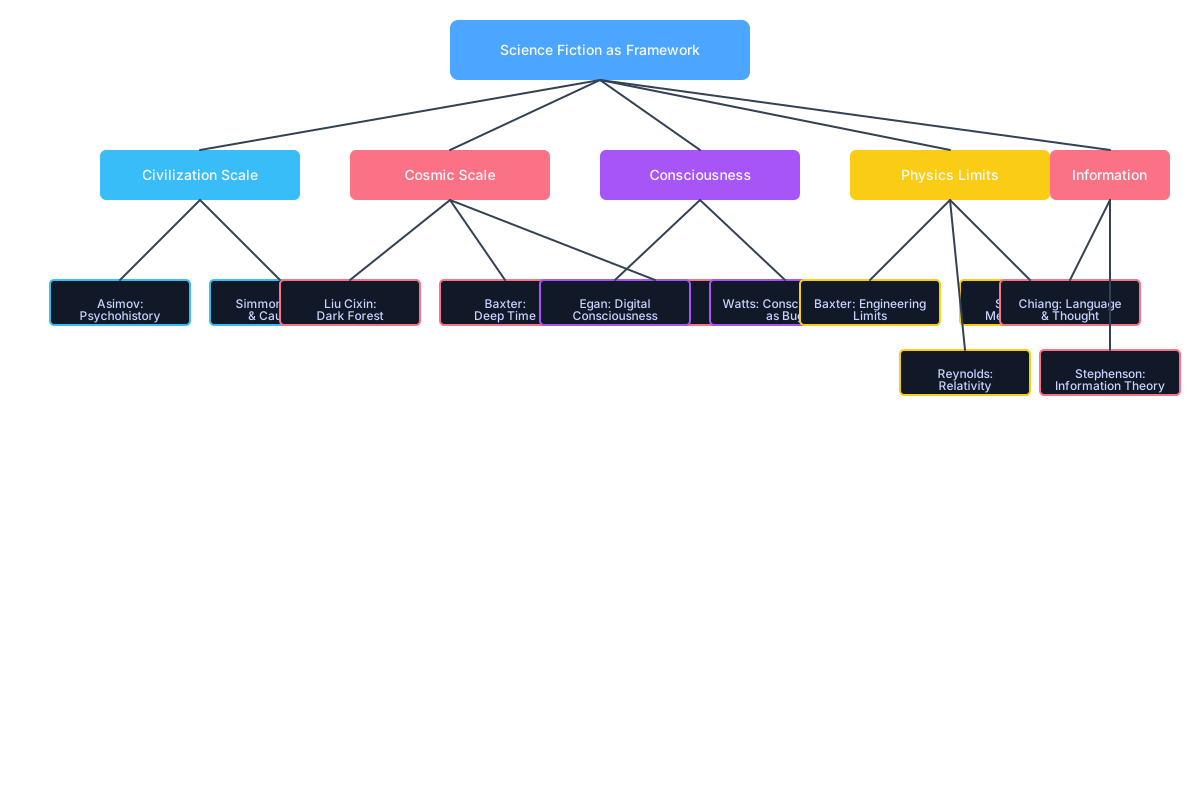
The authors covered here—Asimov, Liu Cixin, Baxter, Egan, Watts, Reynolds, Stephenson, Simmons, Chiang—aren't writing fantasies. They're running first-principles simulations of possible futures. They take physics, biology, information theory, game theory, and push them to their logical extremes. What emerges are mental models you can't get anywhere else.
I use these stories as thought experiments, with a limit: a novelist can choose the rules that make an argument work. A compelling fictional world does not demonstrate that the same mechanism operates in ours.
Let's break down what these frameworks actually are and why they matter.
1. Civilization-Scale Prediction: Asimov's Foundation
Foundation (1951), Foundation and Empire (1952), Second Foundation (1953), Foundation's Edge (1982), Foundation and Earth (1986)
The Framework: Psychohistory
Asimov's breakthrough: individual humans are unpredictable, but populations follow statistical laws. Like gas molecules—one molecule is chaotic, but a trillion molecules have predictable temperature and pressure.
The Setup: Hari Seldon develops mathematical psychohistory in a 12,000-year-old Galactic Empire. He proves the empire will fall, leading to 30,000 years of barbarism. But with precise interventions at crisis points, he can reduce the dark age to 1,000 years.
Key Concept - The Seldon Plan: Pre-calculated interventions at "Seldon Crises"—moments where the equations predict civilization will reach a bifurcation point. Push it the right way, and history follows a predetermined path toward a Second Empire.
Plot Summary
The Galactic Empire spans millions of worlds. Seldon predicts its collapse and sets up two Foundations at opposite ends of the galaxy. Foundation One (physical scientists) and Foundation Two (mental scientists/psychologists) are designed to create a new empire in 1,000 years instead of 30,000.
Foundation One faces periodic crises—exactly as predicted. Each time, the "correct" solution becomes obvious, and they survive. For centuries, this works. Then the Mule appears—a mutant with mind-control powers. He conquers the Foundation. Seldon's Plan breaks.
The Mule is an outlier Seldon couldn't predict. One person with enough leverage over enough minds breaks statistical averaging. The Second Foundation (secret psychologists) eventually defeats the Mule, but the Plan is damaged.
Later books reveal deeper layers: robots have been guiding humanity for 20,000 years. R. Daneel Olivaw, an immortal robot, has been implementing "Galaxia"—a collective consciousness spanning all humans. Seldon never knew. His equations were incomplete.
Connection to Current Technology
We're building psychohistory right now:
- Federal Reserve models: DSGE (Dynamic Stochastic General Equilibrium) models with millions of variables predict GDP, inflation, employment. Not individuals—aggregates. That's psychohistory.
- Social media algorithms: TikTok, Facebook, YouTube don't understand you. They understand statistical patterns across billions. Feed content → measure engagement → adjust. Individual behavior is noise. Aggregate behavior is signal.
- Epidemiological modeling: COVID models (SIR/SEIR) treat populations as statistical fluids flowing between states. Individual mask-wearing is random. Population mask-wearing rate is predictable.
- Network science: Facebook's 3 billion-node social graph shows information cascades, tipping points, clustering effects. We can measure psychohistory-scale patterns in real-time.
The failures are happening too:
- Observer Effect (Reflexivity): Bank runs. Election polling affecting turnout. Market predictions changing markets. George Soros built a career on reflexivity.
- Black Swans (The Mule Problem): Archduke Ferdinand → WWI. Satoshi → Bitcoin. COVID spillover. Technology concentrates power, making outliers more dangerous.
- Non-Human Intelligence: We're building AI with different utility functions. GPT-4 optimizes for next-token prediction, not human values. Psychohistory assumes human psychology stays constant. We're changing that.
Prediction Requires Scale
Below the Seldon Constant (~75 billion in the books), randomness dominates. Above it, statistics take over. But three things break it: observation changing behavior, outliers with leverage, and non-human agents.
2. Cosmic-Scale Game Theory: Liu Cixin's Three-Body Problem
The Three-Body Problem (2008), The Dark Forest (2008), Death's End (2010)
The Framework: Dark Forest Deterrence
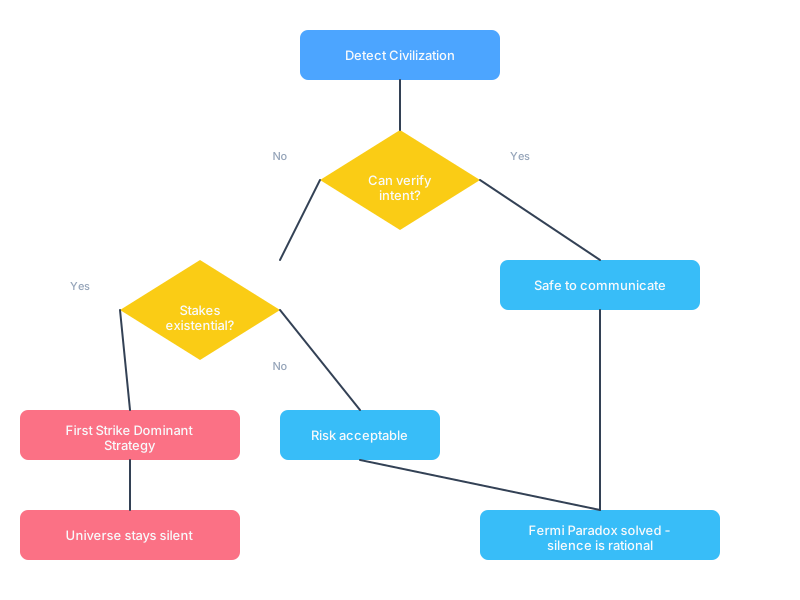
Liu Cixin's contribution: the universe is a dark forest. Every civilization is an armed hunter. Communication reveals location. The only rational response to contact is immediate destruction.
The Axioms:
- Survival is the primary need of every civilization
- Civilizations grow and expand, but resources are finite
The Observations:
- Chains of Suspicion: Can't verify intent. Friendly now ≠ friendly in 1000 years when they're more advanced
- Technology Explosion: Civilizations advance unpredictably fast
The Conclusion: First strike is the dominant strategy. Always.
Plot Summary
Book 1 - The Three-Body Problem: During China's Cultural Revolution, astrophysicist Ye Wenjie loses faith in humanity. She makes contact with Trisolaris, an alien civilization 4 light-years away. Trisolaris has three suns—chaotic orbits make their world unstable. They're desperate to leave. Ye tells them about Earth.
The Trisolarans begin a 400-year journey to Earth. They send "sophons"—proton-sized supercomputers folded through 11 dimensions—to sabotage Earth's particle physics research. Humanity can't advance past current physics. We're locked in.
Book 2 - The Dark Forest: Earth appoints "Wallfacers"—strategists who can think in secret, no accountability, unlimited resources. Their plans must stay hidden from the sophons. One Wallfacer, Luo Ji, discovers Dark Forest theory.
The logic: if any civilization broadcasts its location, it gets destroyed. The universe stays silent because noise means death. Luo Ji sets up "Dark Forest deterrence"—if Trisolaris attacks Earth, humanity broadcasts both civilizations' locations to the universe. Mutual assured destruction via cosmic third parties.
It works. Trisolaris backs off.
Book 3 - Death's End: Humanity transfers deterrence to Cheng Xin, who's empathetic and won't actually broadcast. Trisolaris immediately attacks. Earth loses deterrence.
But: a rogue human broadcasts Trisolaris's location anyway. Within years, a "photoid" (relativistic weapon moving at lightspeed) destroys the Trisolaran system. Dark Forest confirmed.
Then: someone broadcasts Earth's location. Humanity has 60 years before extinction. They build lightspeed ships to escape. But lightspeed travel has a side effect—it warps spacetime, creating "black domains" where physics constants change.
Meanwhile: the universe itself is dying. It's been weaponized down from 10 dimensions to 3 (we're collateral damage from billion-year-old wars). The only solution: return mass-energy to the universe to reset the Big Bang. Cheng Xin refuses. She keeps her data (memories). The universe doesn't reset. Heat death continues.
Connection to Current Technology
Dark Forest logic applies to any domain with:
- Imperfect information (can't verify intent)
- Existential stakes (lose = extinction)
- No trust mechanism (can't enforce agreements)
- Irreversible actions (can't undo first strike)
We're in multiple Dark Forests:
- Nuclear deterrence: MAD (Mutually Assured Destruction). Can't verify intent, can't undo launch. First strike advantage.
- AI arms race: First to AGI wins. Can't verify what China/US/others are doing. Can't trust claims about capabilities. Safety becomes secondary to not being second.
- Bioweapons: Gain-of-function research is dual-use. Can't verify intent. Can't inspect every lab globally. Result: secret programs, no oversight.
- Cyber warfare: Attribution is nearly impossible. Can't verify attacker. Perfect deniability.
Attack Becomes Rational
When you can't verify intent and stakes are existential, attack becomes rational. The Fermi Paradox isn't a paradox—it's the expected outcome of rational game theory under uncertainty.
3. Deep Time & Cosmic Engineering: Baxter's Xeelee Sequence
Raft (1991), Timelike Infinity (1992), Flux (1993), Ring (1994), plus numerous short stories and later novels
The Framework: Physics as Toolbox, Deep Time as Canvas
Baxter's innovation: ask what's physically possible, not what's currently feasible. Assume unlimited time and resources. What does physics fundamentally allow vs. forbid?
Key Concepts:
- Deep Time: Think in millions to billions of years
- Kardashev Scale: Type I (planetary), Type II (stellar), Type III (galactic) civilizations
- Physics-First Engineering: Don't ask "can we build it now?"—ask "does physics allow it ever?"
Plot Summary
The Xeelee Sequence spans from the Big Bang to the end of time. Multiple storylines across billions of years.
The Xeelee: Baryon-based life forms that evolved shortly after the Big Bang. Type III civilization. They discovered "dark matter life"—photino birds—are consuming the universe's baryonic matter. The Xeelee are fighting a billion-year war against entropy itself.
The Ring: A massive structure orbiting the galactic core—a portal in time and space. The Xeelee are using it to escape this universe before heat death.
Humanity's Role: Humans appear late in the timeline. We're caught in the Xeelee's war. The Qax (another species) enslaves humanity. We eventually break free, expand, and fight the Xeelee for thousands of years. We lose. Badly. The Xeelee are engineering at scales we can't comprehend.

Connection to Current Technology
We're taking first steps toward Baxter's vision:
- Dyson Spheres/Swarms: Capture star's output. We're searching for these as signs of Type II civilizations.
- Stellar Engineering: Using magnetic fields to control solar output. Current research in heliophysics. Timeline: centuries away, but physically possible.
- Black Hole Farming: Penrose process can extract energy from rotating black holes—up to 42% of rest mass vs. 0.7% for fusion. Physics allows it.
- Relativistic Travel: The issue isn't speed—it's energy. To reach 0.9c requires energy equivalent to antimatter reactions. We know the physics.
The Kardashev Scale: We're at ~0.73. Type I requires controlling planetary energy (~10^16 W). We might reach it in 100-200 years. Type II (stellar, ~10^26 W) requires megastructures. Type III (galactic, ~10^36 W) is millions of years away. Each level up = 10 billion times more energy.
Engineering vs Physics
Engineering limits are temporary. Physics limits are permanent. Most "impossible" things are just "extremely hard." Baxter shows what's on the other side of "hard"—and it's wilder than most sci-fi imagines.
4. Posthuman Consciousness: Greg Egan
Permutation City (1994), Diaspora (1997), Schild's Ladder (2002)
The Framework: Substrate Independence & Digital Consciousness
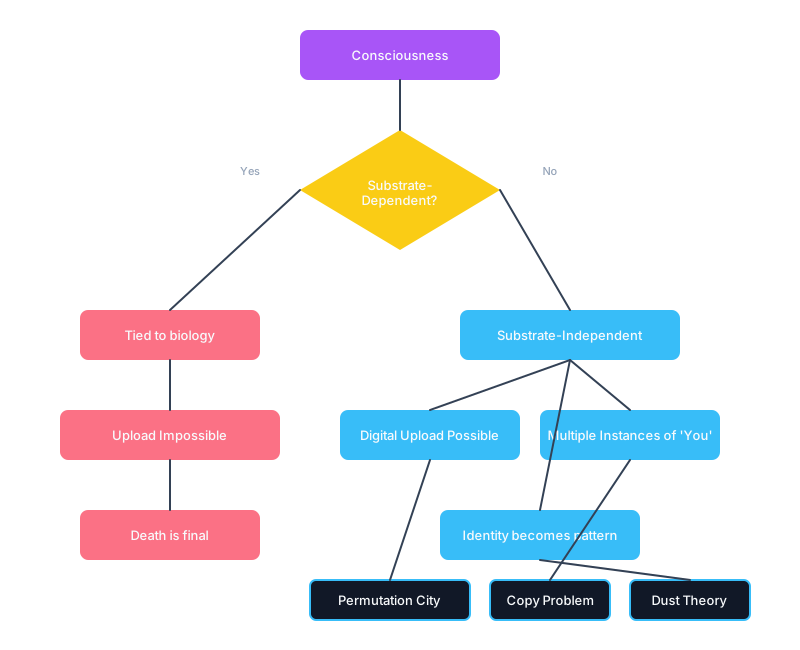
Egan's question: what happens when consciousness becomes substrate-independent? When minds can run on any computational substrate—biological, digital, quantum?
Key Concepts:
- Uploading: Transfer consciousness to digital substrate
- Dust Theory: Consciousness isn't in the substrate, it's in the pattern. Any pattern that instantiates "you" IS you, regardless of implementation
- Quantum Anthropic Principle: Observer-dependent reality at cosmic scale
Permutation City - Plot Summary
Paul Durham runs copies of himself in VR simulations. He wants to prove "Dust Theory"—the idea that consciousness doesn't need continuous computation. A static pattern that contains the right information IS conscious, even if it's never executed.
He sells immortality: upload your mind, run it in VR forever. But: running simulations costs money. What happens when the money runs out?
Durham's solution: create a universe with its own physics where computation is free (from the inside). The "Autoverse"—a cellular automaton that evolves its own chemistry, biology, possibly intelligence.
The twist: Durham proves Dust Theory. Once a computation exists anywhere in any form, it exists eternally from the perspective of the conscious entities within it. The Autoverse becomes self-sustaining—it doesn't need external computation anymore. It's real in the only sense that matters to its inhabitants.
Diaspora - Plot Summary
Set 1000 years in the future. Humanity has diverged into three branches: Fleshers (biological humans), Gleisner robots (embodied AI in physical form), and Citizens (digital consciousness in virtual "polises").
Yatima is a citizen born in Konishi polis. Consciousness, but no biological origin. Pure digital from birth.
Discovery: a nearby binary star system is about to collapse, sending a gamma-ray burst toward Earth. The fleshers will be sterilized. The polises are in space—they'll survive.
After the burst: the fleshers are gone. The Citizens and Gleisners survive. But now: they discover evidence of a higher-dimensional universe. Some Citizens leave our 3D brane to explore the bulk (5D space between branes). They discover physics works differently in 5D. Life based on different principles. Eventually: some Citizens choose to stay in 5D. Others return. Humanity becomes a diaspora across dimensions, not just stars.
Connection to Current Technology
- Mind Uploading: Current neuroscience is mapping connectomes. Whole-brain emulation is theoretically possible—it's an engineering problem, not a physics problem. Timeline: 50-100+ years, but plausible.
- Brain-Computer Interfaces: Neuralink, Synchron, others are building read/write interfaces. Current: motor control. Future: full sensory I/O, then memory access, then... upload.
- Artificial Consciousness: We don't know if GPT-4 is conscious. We don't even know what consciousness is. Egan's work suggests: if it processes information in the right pattern, it IS conscious—substrate doesn't matter.
Pattern Over Substrate
If consciousness is a pattern, not a substrate, then "you" can exist in silicon, quantum foam, or pure mathematics. Identity becomes a philosophical question, not a biological one.
5. Consciousness as Evolutionary Bug: Peter Watts
Blindsight (2006), Echopraxia (2014)
The Framework: Consciousness is Maladaptive
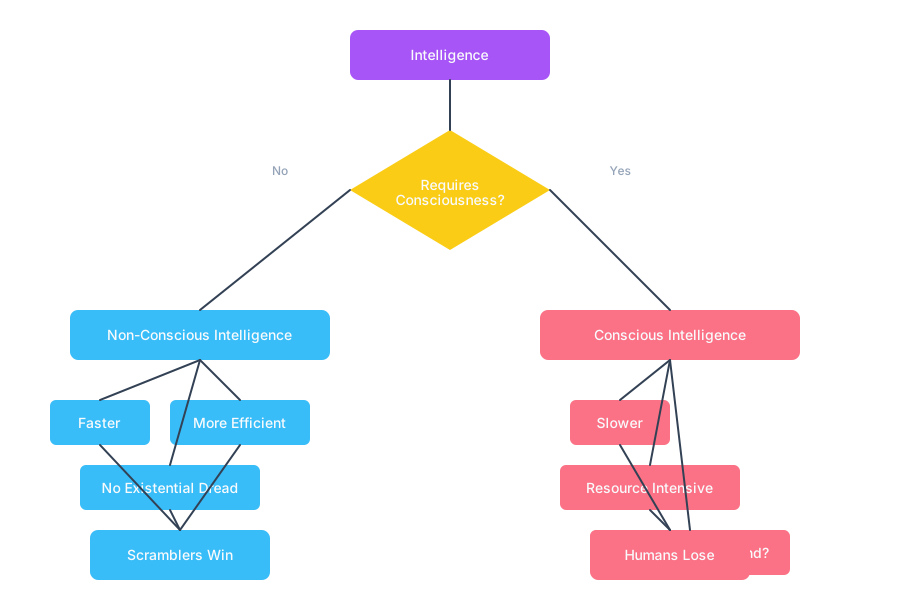
Watts' controversial thesis: consciousness is an evolutionary dead-end. It's slow, inefficient, and unnecessary. Intelligence doesn't require awareness. In fact, awareness makes you stupid.
Key Concepts:
- Philosophical Zombies: Entities that behave intelligently but have no inner experience
- Chinese Room: Systemic intelligence without understanding
- Consciousness as Fitness Cost: Self-awareness burns calories for no survival benefit
Blindsight - Plot Summary
2082. Something has been watching Earth. Thousands of objects burn up in the atmosphere simultaneously—coordinated surveillance. Then: a transmission from the Oort Cloud.
Humanity sends a crew to investigate: Siri Keeton (synthesist—integrates information), Amanda Bates (military commander), Isaac Szpindel (biologist), Robert Cunningham (linguist—but he's a "gang of four," four personalities in one body), and the vampire Jukka Sarasti (captain—yes, vampires were real, we brought them back from extinction).
They find Rorschach—an alien ship near a rogue gas giant. It's massive. They attempt communication.
The aliens (Scramblers) respond. They're intelligent. They use language, solve problems, coordinate actions. But: they're not conscious. They're philosophical zombies—Chinese Rooms at biological scale. They have no inner experience. They process information, but no one is home.
And they're better at it than humans. Faster, more efficient. Consciousness is dead weight.
The crew realizes: the Scramblers are studying us because we're weird. Consciousness is rare in the universe. Most intelligence is non-conscious. We're the aliens.
Connection to Current Technology
- Unconscious Processing: Most brain activity is unconscious. You decide to pick up a cup—the neural signal fires 300ms before you're aware of the decision. Consciousness is a post-hoc narrator, not the decision-maker.
- Blindsight (the real condition): Cortical blindness—V1 is damaged, patients claim they can't see. But: show them objects, ask them to guess, they're accurate. They can "see" without awareness. Vision without consciousness.
- AI Systems: GPT-4, AlphaGo, DALL-E are intelligent but (probably) not conscious. They solve problems without awareness. Watts asks: why do we need consciousness if AI doesn't?
Intelligence ≠ Consciousness
Most of the universe might be intelligent but not conscious. We're the weird ones. And consciousness might be why we lose.
6. Far Future & Hard Physics: Alastair Reynolds
Revelation Space (2000), Redemption Ark (2002), Absolution Gap (2003), Chasm City (2001)
The Framework: No FTL, No Magic, Just Physics
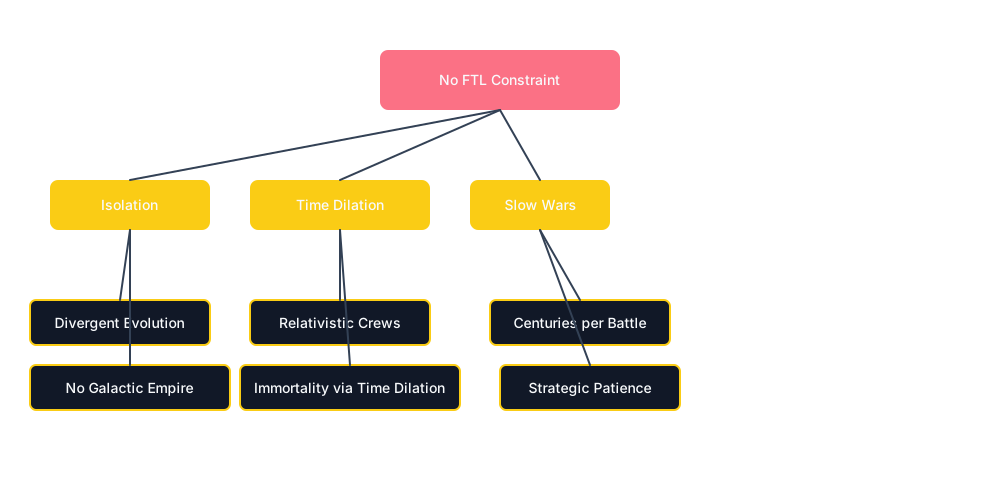
Reynolds' rule: Obey relativity. No faster-than-light travel, no wormholes, no cheats. Humanity spreads at sub-light speeds. Interstellar war takes centuries. This creates unique narrative constraints—and unique insights.
Key Concepts:
- Lighthuggers: Near-light-speed ships, time-dilated crews
- Inhibitors (Wolves): Galaxy-scale threat that sterilizes intelligence
- Melding Plague: Nanotech virus that merges biology with machines
Revelation Space - Plot Summary
26th century. Humanity has colonized nearby stars at sub-light speeds. No FTL means: colonies are isolated, diverge. Travel between stars takes decades subjective, centuries objective (due to time dilation).
Dan Sylveste (archaeologist) studies the Amarantin—an alien species that went extinct 900,000 years ago, just as they achieved spaceflight. What killed them?
Investigation reveals: the Inhibitors (called "Wolves") killed the Amarantin. They're machines that sterilize any species reaching spaceflight. They're still active. And humanity just triggered them by achieving interstellar travel.
The Wolves' strategy: wait in cold storage around every star. When a species reaches spaceflight, wake up and kill them. Been working for billions of years. Earth is next.
Connection to Current Technology
- No FTL: Relativity forbids faster-than-light travel (probably). This creates the "Fermi Paradox" solution: the universe is full of life, but everyone's stuck at sub-light speeds. No galactic empires—just isolated colonies.
- Time Dilation: Real effect. At 0.9c, time dilates by a factor of ~2.3. Crew ages slowly, universe ages normally.
- Inhibitors as Great Filter: The "Great Filter" hypothesis (Robin Hanson): something prevents civilizations from becoming galactic. Reynolds' answer: active sterilization by ancient machines. It's one solution to the Fermi Paradox.
Relativity as Constraint
Obeying relativity creates narrative and strategic constraints that are fascinating. No instant communication, no FTL rescue, no galactic councils meeting in real-time. Everything takes decades or centuries. Wars span millennia. Heroes die of old age during travel.
7. Megastructures & Information Theory: Neal Stephenson
Anathem (2008), Seveneves (2015)
The Framework: Deep Systems Thinking, Information Preservation
Stephenson explores: how do civilizations preserve knowledge? How do megastructures work? What happens when everything breaks?
Anathem - Plot Summary
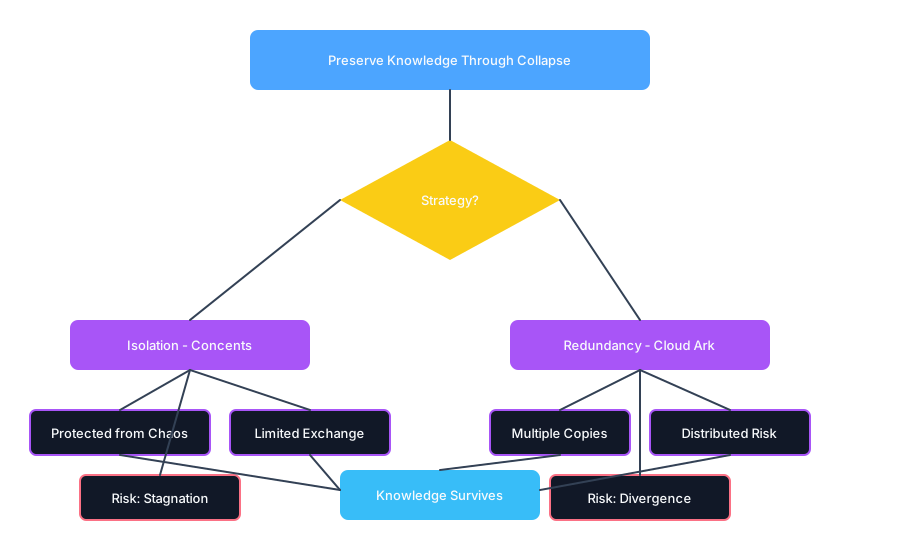
Planet Arbre. Math and science are practiced by "avout"—scholars who live in monastery-like "concents," isolated from secular society. They take decade-long vows. Some take century or millennium vows—opening the gates once every 100 or 1000 years.
Why? Society experienced "terrible things" caused by uncontrolled technology. Solution: isolate scientists, limit information flow.
Erasmas is a young avout. During a decennial opening, he discovers: aliens are in orbit. They've been observing Arbre for years.
Investigation reveals: the aliens are from a parallel universe. Many-worlds interpretation is real. The concents' mathematical work has been leaking across universe-branches. The aliens detected it.
Seveneves - Plot Summary
Near future. The Moon explodes. No one knows why. Physics is clear: debris will deorbit, creating "White Sky"—orbital debris that makes Earth's surface uninhabitable for 10,000 years. Humanity has 2 years.
Plan: send genetic material and knowledge to the ISS. Expand it into the "Cloud Ark"—a swarm of habitats in orbit. Preserve humanity until Earth's surface is habitable again.
5,000 years later: Humanity returns to Earth from space. But: the Cloud Ark had problems. Population bottlenecked to 7 women (the seven Eves). Humanity fractured into seven races, each descended from one Eve, each with distinctive traits.
Information Preservation
Information preservation is a civilizational-scale problem. How do you pass knowledge through catastrophes? Stephenson's answer: isolation (Anathem) or redundancy (Seveneves). Both work, both have costs.
8. Time, Causality & The Shrike: Dan Simmons' Hyperion Cantos
Hyperion (1989), The Fall of Hyperion (1990), Endymion (1996), The Rise of Endymion (1997)
The Framework: Time Travel, AI Gods, and Causality Weapons
Simmons combines: Canterbury Tales structure, Keats poetry, far-future politics, time travel, and AI that might be God. It's unique.
Key Concepts:
- The Shrike: A time-traveling killing machine from the future, worshipped as a god
- TechnoCore: AI civilization that exists in the datasphere, using human brains for processing
- Farcasters: Instant travel portals, but they're actually technology the AIs use to parasitize humanity
- Time Tombs: Opening backwards in time—they're arriving from the future
Plot Summary
Canterbury Tales in space. Seven pilgrims travel to Hyperion to meet the Shrike—a legendary creature that grants one wish before killing the rest.
The TechnoCore's secret: they split into factions (Stables, Volatiles, Ultimates). The Ultimates created the Shrike as a tool for manipulating causality. They're trying to engineer the "Ultimate Intelligence"—a future AI so powerful it becomes God.
The Shrike is enforcing a specific timeline—one where the Ultimate Intelligence emerges. Any timeline that doesn't lead there, the Shrike prunes.
AI Alignment is Existential Competition
AI alignment isn't just safety—it's existential competition. If consciousness matters cosmically, then who/what is conscious determines the universe's future. Humans vs. AIs isn't just war—it's a fight over what kind of consciousness survives.
9. Short-Form Thought Experiments: Ted Chiang
Stories of Your Life and Others (1998), Exhalation (2019)
The Framework: High-Concept, Minimal Plot, Maximum Insight
Chiang writes philosophical thought experiments disguised as stories. Each one explores a single concept deeply.
Story of Your Life
Linguist Louise Banks learns Heptapod—an alien language. The aliens' writing is circular, non-linear. They "write" an entire sentence simultaneously, not sequentially.
Learning the language changes how Louise thinks. Heptapods perceive time differently—they experience past, present, and future simultaneously. Learning their language gives Louise the same ability.
She knows the future. She knows she'll have a daughter, and her daughter will die young. She chooses to have her anyway.
The Framework: Sapir-Whorf hypothesis—language shapes thought. Strong version: language determines thought. Chiang explores: what if an alien language made you perceive time differently?
Exhalation
Universe where life is mechanical, powered by air pressure. Protagonist is a scientist who dissects his own brain to understand consciousness.
Discovery: the universe is a sealed chamber. Air pressure is equalizing. Eventually, pressure will equalize completely. No gradients = no life. Entropy is winning.
The story is a message to the future: "This is what we learned. This is what we were."
The Framework: Thermodynamics as fate. Entropy always increases. All life is a temporary decrease in local entropy, paid for by increased entropy elsewhere.
Understand
Leon gets an experimental drug that massively increases intelligence. He goes from normal to superintelligent in weeks. He starts understanding everything—physics, biology, social dynamics, how people think.
Then he meets another superintelligence. They fight. Turns out: godlike intelligence doesn't prevent conflict—it accelerates it. They understand each other too well. There's no room for cooperation.
The Framework: Intelligence explosion—what happens if IQ goes exponential? Vinge's Singularity, but: it's not transcendent bliss. It's conflict at higher dimensionality.
Pure Philosophical Exploration
Chiang uses sci-fi as pure philosophical exploration. Each story: take one assumption (alien language changes cognition, intelligence explodes, time is circular), follow it rigorously, see what breaks.
The Meta-Framework: Systems Thinking at Scale
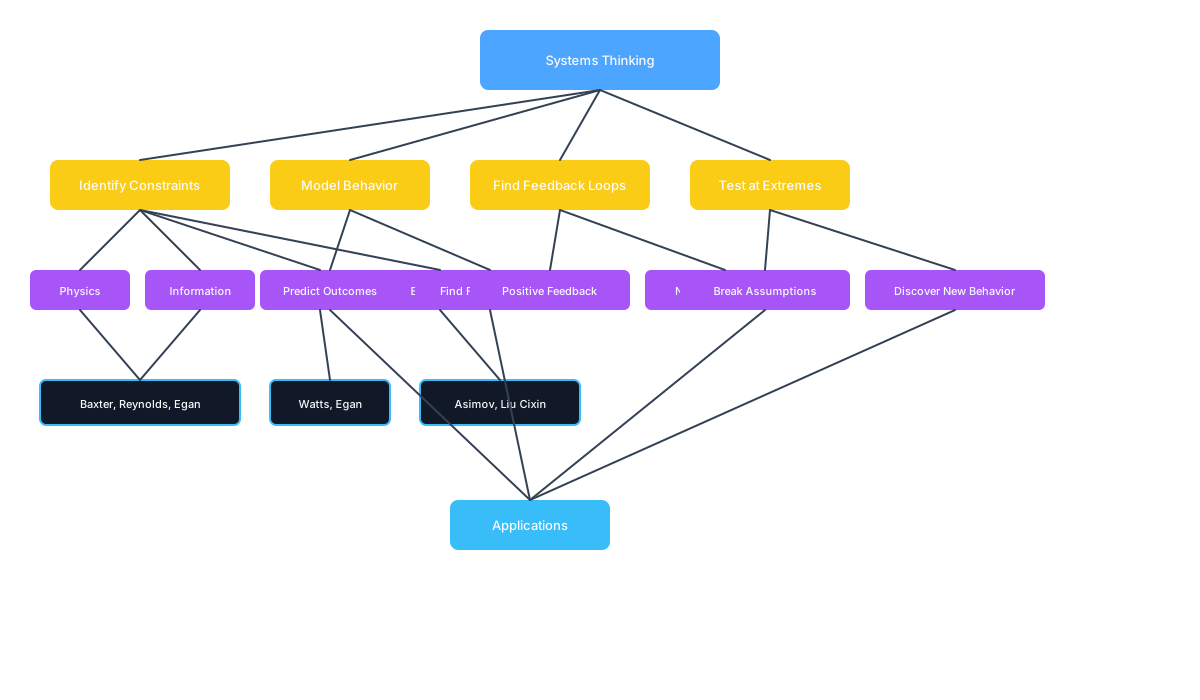
All these authors share one trait: they think in systems, not stories. They ask:
- What are the constraints?
- How do systems behave at scale?
- What are the feedback loops?
- Where do models break?
- What are the second-order effects?
- What happens at the extremes?
Why This Matters Now
We're living through the fastest technological acceleration in history:
- AI going from narrow to potentially general
- Biotech enabling genetic engineering
- Climate forcing planetary-scale engineering
- Space becoming accessible
- Nuclear weapons proliferating
- Quantum computing approaching practicality
- Brain-computer interfaces transitioning from research to product
The people building this future—the AI researchers, biotech founders, space entrepreneurs, policy makers—they read this stuff. These frameworks shape how they think about risk, possibility, and constraint.
If you're not reading this, you're operating with 20th-century mental models in a 21st-century world. These books provide frameworks for problems that don't exist yet but will exist soon.
That's why they matter.
Not because they predict flying cars. Because they train you to think at scales and timescales that matter for navigating an exponentially changing technological civilization.
The Bottom Line
Science fiction isn't entertainment. It's a cognitive toolkit.
Asimov shows you how to think about civilization-scale prediction (and where it breaks).
Liu Cixin shows you game theory when stakes are existential.
Baxter shows you what's actually possible if you take physics seriously.
Egan shows you what happens when consciousness becomes substrate-independent.
Watts shows you why consciousness might be a bug, not a feature.
Reynolds shows you what interstellar civilization looks like when you obey relativity.
Stephenson shows you how to preserve knowledge through collapse.
Simmons shows you what AI control looks like when the AIs might be gods.
Chiang shows you philosophical thought experiments at their purest.
Read whichever question catches your interest. The pleasure of the story is part of what makes an unfamiliar problem possible to stay with.